

State-Run Wind Pools vs. Private Windstorm Insurance: A Side-by-Side Comparison
If you own property along the Gulf Coast, Atlantic seaboard, or any hurricane-prone corridor, you have likely encountered two fundamentally different ways to insure against wind damage: state-run insurance pools and private market windstorm coverage. Understanding how they differ in cost, coverage limits, claims handling, and eligibility can save you thousands of dollars—and weeks of frustration after a storm.
How State-Run Wind Pools Work
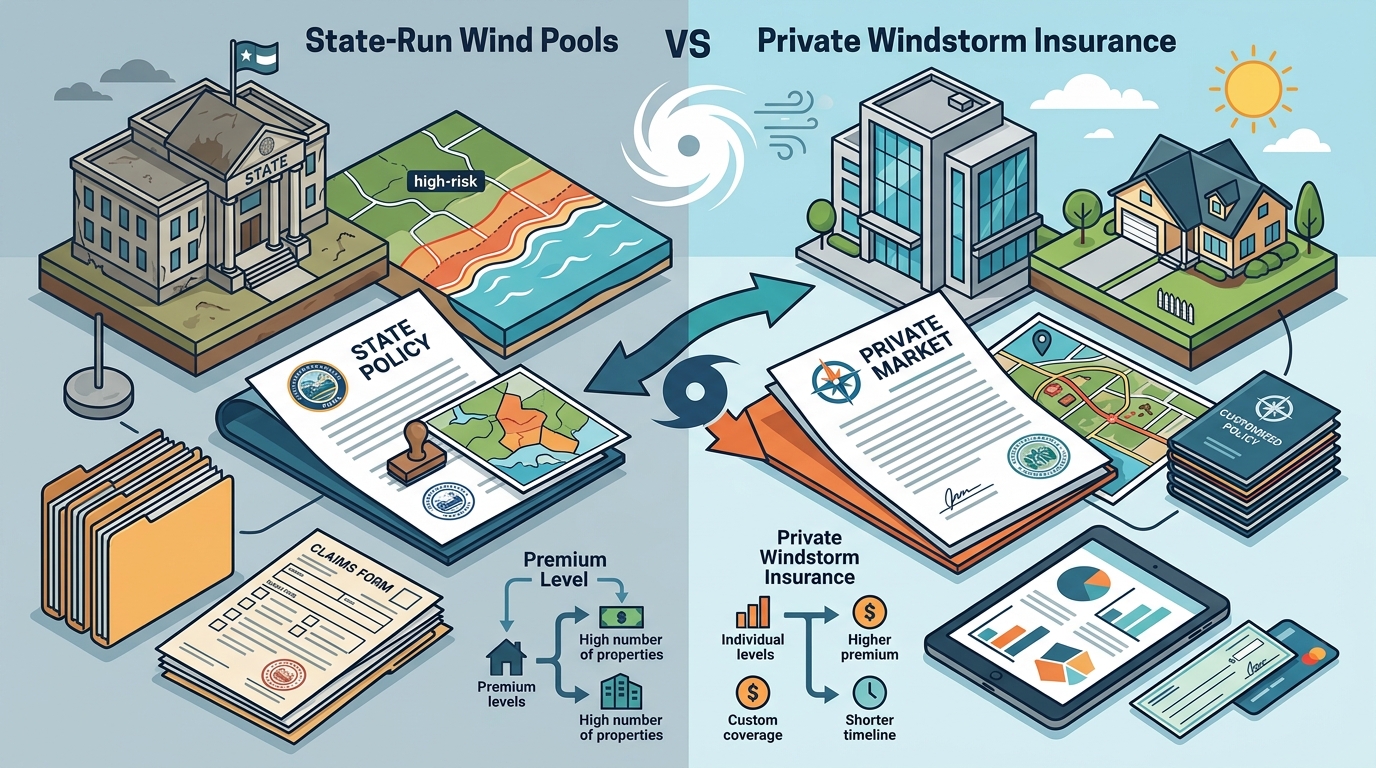
State-run wind pools—also called beach plans, FAIR plans, or windstorm associations—exist because private carriers sometimes refuse to write policies in the riskiest coastal zones. When that happens, the state steps in with a publicly backed program so homeowners are not left completely uninsured.
These programs act as insurers of last resort, offering windstorm policies in high-risk areas where private coverage is unavailable or unaffordable. They are typically funded through policyholder premiums, state assessments, and reinsurance agreements. Each state sets its own guidelines for eligibility, premium rates, and coverage limits.
For instance, in Texas the legislature created the Texas Windstorm Insurance Association (TWIA) in 1971 after Hurricane Celia devastated Corpus Christi and caused $500 million in losses, prompting most private insurers to exit the coastal market. TWIA covers 14 coastal counties and parts of Harris County, issuing wind and hail policies directly.
How Private Market Windstorm Coverage Works
Private windstorm insurance is offered by standard carriers or specialty insurers—companies like USAA, GeoVera, and regional surplus-lines writers. These policies can be standalone windstorm plans or endorsements added to an existing homeowners policy.
Private carriers set their own underwriting criteria, meaning they can be selective about which properties they accept. But they can also offer broader coverage options, replacement-cost valuations, and more flexible deductible structures than state programs typically provide.
Seven Critical Differences at a Glance
| Factor | State-Run Wind Pool | Private Windstorm Policy |
|---|---|---|
| Eligibility | Must prove denial from at least one private insurer | Open to any qualifying property |
| Cost | Generally more expensive; acts as last-resort pricing | Competitive pricing for lower-risk properties |
| Coverage Limits | Capped by statute (e.g., NC FAIR Plan caps at $750K residential) | Customizable limits, often higher ceilings available |
| Valuation Method | May use actual cash value for contents | Replacement cost commonly available |
| Deductibles | Options may be limited (TWIA offers $100, $250, or 1%) | Range of fixed-dollar and percentage options |
| Claims Speed | Can be slower; TWIA has 60-day investigation window | Varies, but competitive pressure incentivizes faster payouts |
| Financial Backing | Funded by premiums, reserve trust funds, assessments on all state insurers, and reinsurance | Backed by insurer surplus, private reinsurance, and capital markets |
1. Eligibility Requirements
The most immediate difference is who can buy a policy. State wind pools require proof that private coverage was denied or unavailable. In Texas, homeowners must show that at least one private insurer has declined to offer wind coverage before TWIA will write a policy. Properties must also pass a windstorm inspection and receive a WPI-8 certificate confirming compliance with building codes.
Private insurers have no such prerequisite—if the property meets their underwriting standards, they will issue coverage. This makes private insurance accessible to a broader population, while wind pools are structurally limited to the hardest-to-insure properties.
2. Premium Costs
State-sponsored programs tend to cost more than private insurance companies because they concentrate the highest-risk properties in a single pool. In Texas, homeowners typically pay about $2,300 per year for a TWIA policy—and that is for wind and hail coverage alone, not a full homeowners policy.
Private carriers, by contrast, can spread risk across a geographically diverse portfolio and underwrite selectively, keeping premiums lower for well-maintained homes in moderate-risk zones. However, in the most hurricane-exposed areas, private pricing—where available at all—can rival or exceed wind pool rates.
3. Coverage Limits and Gaps
State programs often impose statutory caps that may leave high-value properties underinsured. In North Carolina, the FAIR Plan limits residential coverage to $750,000, with personal property capped at 40% of building coverage. Some state FAIR plans offer no liability coverage and pay actual cash value rather than replacement cost on contents.
Private carriers generally allow policyholders to select higher coverage limits and typically offer replacement cost valuation on both the dwelling and personal property—a significant advantage if rebuilding costs spike after a widespread storm.
4. Deductible Structures
Windstorm deductibles in both state and private markets are commonly percentage-based rather than flat-dollar amounts. Deductibles typically range from 1% to 5% of a home's insured value and can reach 10% in some coastal areas. On a $300,000 home, a 5% deductible means you pay $15,000 out of pocket before insurance covers anything.
TWIA offers fixed deductible options of $100, $250, or 1% of coverage—relatively low compared to some private carriers in coastal zones. Private policies may offer greater flexibility, letting homeowners trade higher deductibles for lower premiums or vice versa.
5. Claims Handling and Timelines
Claims processing is where policyholders feel the practical difference most acutely. TWIA has a statutory 60-day window to investigate and accept or reject a claim, followed by 10 days to issue payment. After Hurricane Beryl made landfall in July 2024, TWIA received over 31,000 claims, and the event's total losses reached an estimated $455 million—ultimately depleting the Catastrophe Reserve Trust Fund.
Private insurers are not bound by the same statutory timelines but face competitive pressure and state prompt-payment regulations. Smaller private carriers may handle claims more personally, while large national carriers have established catastrophe-response teams that can mobilize quickly.
6. Financial Stability and Catastrophe Funding
A crucial but often overlooked distinction is how each model pays for catastrophic losses. TWIA's 2025 reinsurance program provides $4.227 billion in coverage in excess of a $2 billion retention, funded through a mix of traditional reinsurance and catastrophe bonds. If losses exceed all available funding, TWIA can levy assessments on every property and casualty insurer in Texas—costs that may ultimately be passed on to policyholders statewide through increased premiums.
Private carriers rely on their own surplus, private reinsurance treaties, and capital-market instruments. A well-capitalized private insurer may be more resilient to moderate storms, but could choose to exit a market entirely after a catastrophic season—exactly the scenario that gave rise to wind pools in the first place.
7. Rate Regulation
State wind pools operate under tight regulatory oversight. Under Texas statute, TWIA is restricted to a 10% average rate increase per year, with a 15% cap on individual rating classes. In late 2024, TWIA's proposed 10% rate increase was rejected by the Texas Department of Insurance after receiving hundreds of public comments.
Private insurers face varying degrees of rate regulation depending on the state. In some states they must file rates for approval; in others they can adjust pricing more freely. This means private rates can respond more quickly to changing risk conditions—sometimes to the benefit of policyholders, sometimes not.
When a State Wind Pool Makes Sense
- You have been declined by at least one private insurer
- You live in a designated coastal county with no private wind options
- Your home meets windstorm building code requirements and has proper certification
- You need a safety-net policy while shopping for private alternatives
When Private Coverage Is the Better Choice
- You can obtain quotes from competitive private carriers
- You want higher coverage limits or replacement cost valuation
- You prefer flexible deductible options to manage out-of-pocket risk
- You value faster claims processing driven by market competition
- Your home has wind-mitigation features (FORTIFIED designation, impact-resistant windows) that earn private-market discounts
Reducing Costs Regardless of Which Path You Choose
Whether you land in a state pool or private policy, wind-mitigation improvements can lower your premiums significantly. Building or re-roofing to FORTIFIED standards is one of the most effective strategies. In states with enacted legislation, a FORTIFIED designation qualifies homeowners for mandated wind premium discounts of 20% to 55%. A 2025 peer-reviewed study found that FORTIFIED Roof homes had 73% fewer insurance claims and 72% lower total losses during Hurricane Sally than conventionally built homes.
Other mitigation steps that commonly earn discounts include:
- Installing hurricane shutters or impact-resistant laminated glass
- Upgrading roof-to-wall and wall-to-foundation connections
- Securing garage doors to withstand wind pressure
- Maintaining proper roof condition and replacing aging shingles
Key Takeaways
- State wind pools are insurers of last resort—they exist for homeowners who cannot find private coverage, not as a first-choice option.
- Private windstorm insurance is typically cheaper and more flexible, but may be unavailable in the highest-risk coastal zones.
- Coverage caps and valuation methods differ sharply—verify whether your policy pays replacement cost or actual cash value.
- Deductibles in both models are usually percentage-based, so know your dollar exposure before a storm hits.
- Claims handling varies—state pools have statutory timelines, while private carriers face market-driven accountability.
- Wind-mitigation improvements reduce premiums in both markets—FORTIFIED certification delivers the largest documented savings.
- Never wait until a storm approaches—insurers may impose moratoriums 24 to 48 hours before a major storm, blocking new policies.
Frequently Asked Questions
What is a state-run wind pool?
A state-run wind pool is a government-backed insurance program that provides windstorm and hail coverage to homeowners in high-risk coastal areas who have been unable to obtain policies through private insurance companies. Examples include TWIA in Texas, Citizens in Florida, and the Coastal Property Insurance Pool in North Carolina.
Is private windstorm insurance cheaper than a state wind pool?
In most situations, yes. State-sponsored programs tend to cost more because they pool the highest-risk properties that private carriers have declined. However, in the most hurricane-exposed coastal areas, private pricing—where available—can be comparable or even higher due to concentrated risk.
Can I choose a state wind pool even if I qualify for private coverage?
Generally no. Programs like TWIA require homeowners to demonstrate that at least one private insurer has denied them wind coverage. Wind pools are structurally designed as a safety net, not a competitive marketplace alternative.
Do state wind pools cover flood damage?
No. Windstorm policies—whether from a state pool or private insurer—cover damage from wind and hail only. Flooding and storm surge require a separate flood insurance policy, typically through NFIP or a private flood carrier.
What states have wind pools or beach plans?
Nineteen states and Washington, D.C. have hurricane deductible requirements or dedicated residual-market programs. States with specific wind pools or beach plans include Texas, Florida, Mississippi, North Carolina, South Carolina, Alabama, and Louisiana. Each state structures its program differently in terms of eligibility, coverage limits, and funding.
What happens if a state wind pool runs out of money after a catastrophic hurricane?
Most state pools have multi-layered funding structures. TWIA, for example, maintains a Catastrophe Reserve Trust Fund, purchases billions in reinsurance, and can levy assessments on all property and casualty insurers in Texas. After Hurricane Beryl in 2024, TWIA withdrew $462.7 million from the CRTF, effectively depleting it—but reinsurance and assessment mechanisms provided additional backstop funding.