
How to Qualify for Windstorm Insurance After Being Rejected by Multiple Providers
Getting rejected for windstorm insurance by one or more providers can feel overwhelming, especially when you live on the Texas Gulf Coast and hurricane season is approaching. The good news is that a rejection does not mean you are out of options. Texas has specific programs and pathways designed to help homeowners who cannot secure coverage through the private market. From obtaining the right building certifications to working with the state's insurer of last resort, there are concrete steps you can take today to protect your home and family. This guide walks you through each one.
Why Windstorm Insurance Applications Get Rejected
Private insurers deny windstorm applications for several common reasons. Your property may lack a valid Windstorm Certificate of Compliance (WPI-8), which proves your home meets wind-resistant building codes. Existing unrepaired damage, a roof in poor condition, or a location in a high-risk flood zone without proper flood coverage can also trigger a denial.
In many cases, the rejection is not permanent. It simply means your property does not meet the insurer's underwriting guidelines at that moment. Understanding why you were denied is the critical first step toward getting approved.
Understanding TWIA: Texas's Insurer of Last Resort
The Texas Windstorm Insurance Association (TWIA) is a quasi-governmental entity created by the Texas Legislature to ensure coastal homeowners can access wind and hail coverage when the private market will not provide it. TWIA is available in 14 first-tier coastal counties, including Galveston County where Texas City is located, plus portions of Harris County east of Highway 146.
As of December 31, 2025, TWIA insured approximately 284,846 properties with roughly $126.5 billion in total insured value. A TWIA policy is a monoline policy, meaning it covers only wind and hail perils. You will still need a separate home insurance policy for fire, theft, and liability protection.
Step 1: Document Your Declinations Properly
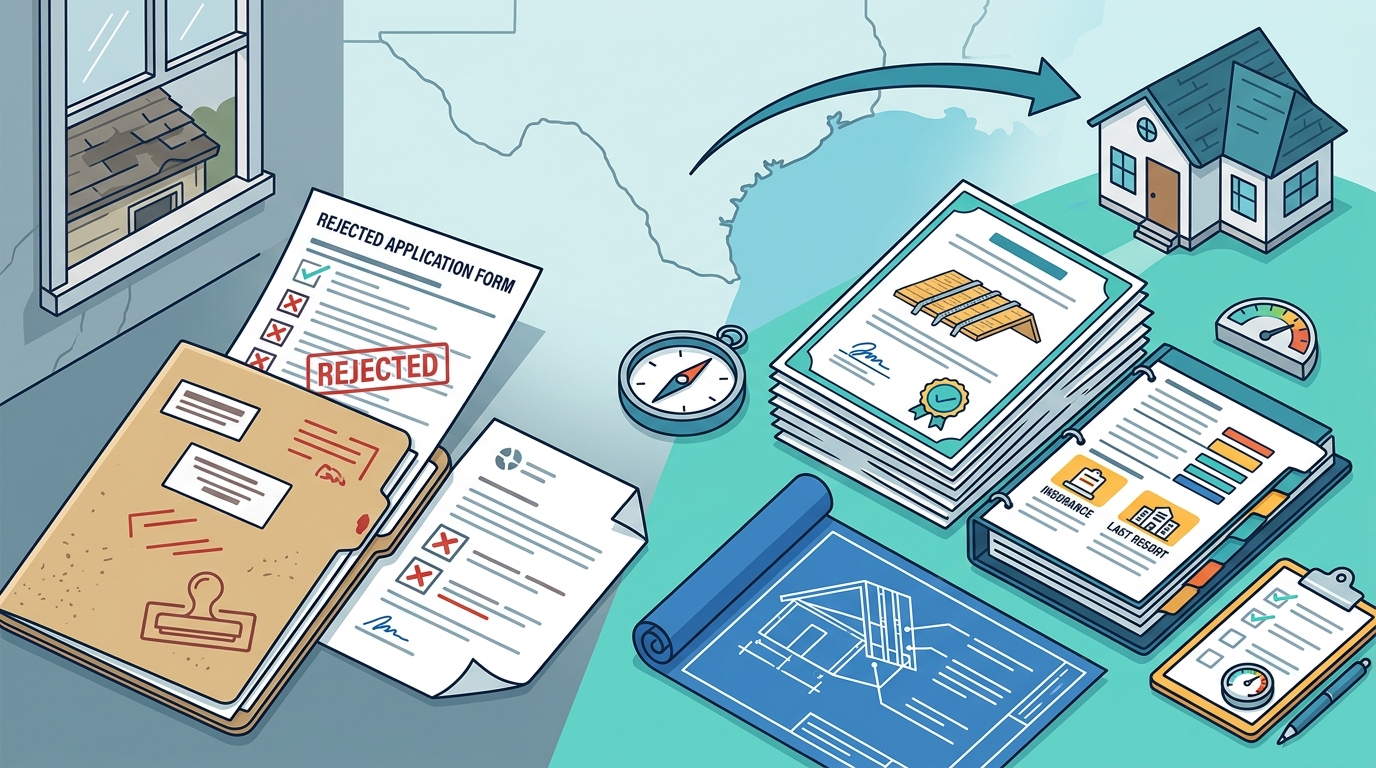
To apply for TWIA coverage, you must prove that at least one authorized insurer has declined to offer you windstorm and hail insurance. A declination is a formal refusal of coverage by an insurer authorized to write property insurance in Texas; surplus lines companies do not qualify for this requirement.
What Counts as a Valid Declination
A declination occurs when an authorized company either refuses coverage outright or offers terms more restrictive than what TWIA provides, such as only offering a very high deductible. You should document the insurer's name, the date of the declination, and the reason for the refusal. TWIA provides a Proof of Declination of Coverage form to simplify this process.
How Often Declinations Are Required
One declination is needed for new coverage. After that, a fresh declination is required every three calendar years for renewal coverage.
Step 2: Obtain a Windstorm Certificate of Compliance
A Windstorm Certificate of Compliance (WPI-8) is a document issued by the Texas Department of Insurance (TDI) confirming that your home was built or repaired to applicable windstorm building codes. Without this certificate, TWIA may consider your property uninsurable.
Types of Certificates
| Certificate | Description | Issued By |
|---|---|---|
| WPI-8 | Standard certificate for new construction or improvements inspected during the building process | Texas Department of Insurance (TDI) |
| WPI-8-E | Equivalent certificate for completed improvements certified retroactively by a professional engineer | Texas Department of Insurance (TDI) |
| WPI-8-C | Certificate for completed construction (accepted by TWIA from Jan 2017 to May 2020; no longer issued by TWIA) | Previously TWIA, now TDI only |
If your home was built before 1988 and has not been significantly altered, it may be grandfathered in. However, any major repairs such as a roof replacement after that date must be inspected and certified. You can verify whether your property already has a certificate using TDI's online database.
Step 3: Bring Your Property Into Insurable Condition
TWIA requires that your property be maintained in good repair, with no unrepaired damage or hazardous conditions. If a previous storm left damage you never fixed, that alone can disqualify you from coverage. TWIA inspects properties either in person or remotely using aerial imagery and risk management reports.
Before applying, walk your property and address common issues: missing shingles, broken windows, damaged siding, and deteriorated roofing materials. Investing in repairs now can save you from a denial later. Learn more about windstorm insurance benefits and coverage details to understand what inspectors look for.
Step 4: Secure Flood Insurance if Required
Flood insurance is a separate policy that covers property damage caused by rising water, which is not included in standard homeowners or windstorm policies. If your property is located in flood zones V, VE, or V1-30 and was constructed or modified on or after September 1, 2009, you must provide proof of flood insurance through the National Flood Insurance Program (NFIP) before TWIA will issue your windstorm policy.
Even if it is not required for TWIA eligibility, carrying flood coverage is strongly recommended for any coastal Texas homeowner. Brad Spurgeon Insurance Agency can help you find affordable flood insurance options tailored to your property.
Step 5: Work With a Licensed Coastal Insurance Agent
TWIA does not sell policies directly. You must purchase coverage through a licensed insurance agent in Texas who is appointed to write TWIA policies. An experienced agent in the coastal market can also explore private windstorm carriers on your behalf. Brad Spurgeon Insurance Agency, located at 1118 14th Street North in Texas City, now offers windstorm coverage with two private companies in addition to TWIA, giving you more options even after multiple rejections.
A local agent understands the nuances of Galveston County underwriting, WPI-8 requirements, and the declination process. That expertise can be the difference between another denial and a bound policy.
Private Windstorm Carriers vs. TWIA: A Quick Comparison
| Feature | Private Windstorm Carrier | TWIA |
|---|---|---|
| Availability | Varies by insurer and risk profile | 14 first-tier coastal counties + parts of Harris County |
| Declination required? | No | Yes, at least one authorized insurer |
| WPI-8 required? | Often, but varies | Yes, for most properties built/modified after 1988 |
| Residential coverage limit | Varies | $1,773,000 maximum |
| 2026 rate change | Market-driven | 0% increase (per HB 3689) |
| Deductible options | Varies | $100, $250, or 1% |
| Average annual cost | Varies | ~$2,480/year |
For homeowners whose property value exceeds TWIA's $1,773,000 cap, a private excess wind policy is essential to avoid being underinsured. Explore your windstorm coverage choices to find the right fit.
Key Takeaways
- A windstorm insurance rejection does not mean you are permanently uninsurable. Texas provides a safety net through TWIA.
- You need at least one documented declination from an authorized insurer to qualify for TWIA coverage.
- A Windstorm Certificate of Compliance (WPI-8) is mandatory for most properties built or modified after 1988.
- Your property must be in good repair with no unrepaired damage or hazardous conditions.
- Flood insurance may be required before TWIA will issue your windstorm policy, depending on your flood zone.
- Private windstorm carriers are now available on the Texas Gulf Coast as alternatives to TWIA.
- Working with a licensed local agent who specializes in coastal insurance dramatically improves your chances of approval.
Frequently Asked Questions
What is TWIA?
TWIA is the Texas Windstorm Insurance Association, a state-created insurer of last resort that provides wind and hail coverage to homeowners in designated coastal counties who cannot obtain coverage through the private market.
How many rejections do I need before applying to TWIA?
You need just one declination from an authorized insurer that actively writes windstorm and hail coverage in first-tier coastal counties. Surplus lines companies do not count.
What is a WPI-8 certificate?
A WPI-8 is a Windstorm Certificate of Compliance issued by the Texas Department of Insurance confirming that a property meets applicable windstorm building codes for its area.
Can I get windstorm insurance without a WPI-8?
In most cases, no. Properties built or modified after 1988 generally require a valid WPI-8 or WPI-8-E. If your home lacks one, you may need to hire a professional engineer for a retroactive certification, which can be costly.
Does TWIA cover flood damage?
No. TWIA is a monoline policy that covers only wind and hail damage. You need a separate flood insurance policy, typically through the NFIP or a private insurer, to cover flooding.
How much does TWIA coverage cost on average?
TWIA coverage costs approximately $2,480 per year on average, though your actual premium depends on your property's location, value, age, and construction type. TWIA implemented a 0% rate increase for 2026.
Are there private alternatives to TWIA in Texas?
Yes. Several private carriers now offer windstorm coverage along the Gulf Coast. Brad Spurgeon Insurance Agency works with two private windstorm companies in addition to TWIA, giving homeowners more flexibility and potentially better terms.
What happens if TWIA also denies my application?
If TWIA denies your application due to building code non-compliance or property condition issues, you can address those issues and reapply. You may also explore the Texas FAIR Plan for basic property coverage while you work toward full eligibility.
Get Help With Your Windstorm Policy Today
If you have been rejected for windstorm insurance and are unsure what to do next, Brad Spurgeon Insurance Agency can help. With over 20 years of experience serving Texas City and the surrounding Gulf Coast communities, we specialize in finding coverage solutions for homeowners who have been turned away elsewhere. Contact us for a free consultation and let us review your property, certifications, and options so you can protect your home before the next storm arrives.