

How to Qualify for Windstorm Insurance After Being Rejected
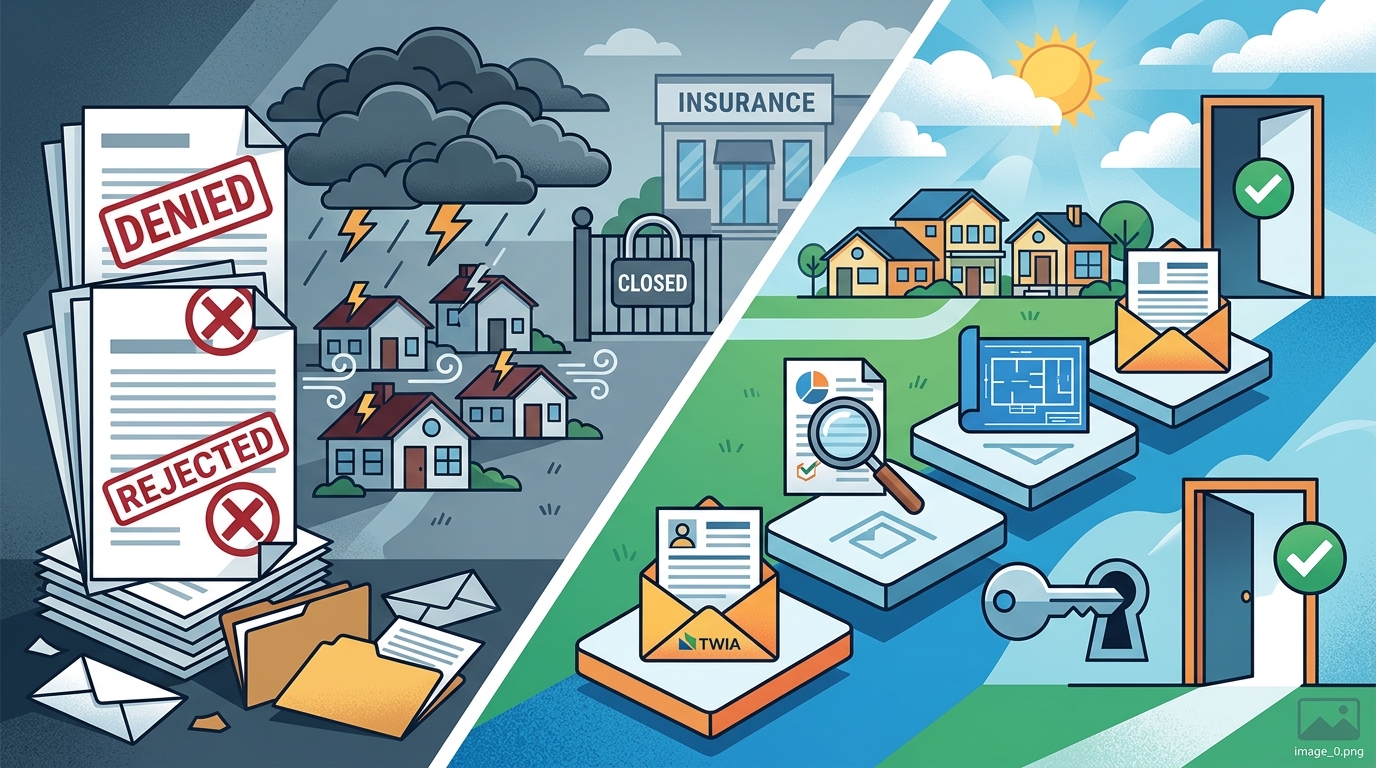
Getting rejected for windstorm insurance by multiple providers can feel overwhelming, especially when you live along the Texas Gulf Coast where coverage is not optional. The good news is that rejection does not mean you are out of options. Texas has built-in safety nets, including the Texas Windstorm Insurance Association (TWIA), specifically designed for homeowners who cannot secure coverage through the private market. In this guide, we walk you through every step you need to take to qualify for a windstorm policy after one or more denials, from understanding why you were rejected to getting your property certified and your application submitted.
Why Windstorm Insurance Applications Get Rejected
Before you can fix the problem, you need to understand what caused it. Private insurers in coastal Texas frequently decline windstorm applications for several common reasons.
Property Condition and Code Compliance
The most frequent reason for denial is a property that does not meet current windstorm building codes. An aging roof, unrepaired storm damage, or hazardous conditions can all trigger a rejection. As the TWIA eligibility page states, properties must be maintained in an insurable condition with no unrepaired damage.
Missing Windstorm Certificate
A WPI-8 is a Certificate of Compliance issued by the Texas Department of Insurance. It proves your home was built or repaired to withstand high-wind speeds. Without one, both private insurers and TWIA may consider your property uninsurable.
Geographic Risk
Homes in the 14 first-tier coastal counties face higher rejection rates from private carriers because insurers limit their exposure in areas prone to windstorm damage. These counties include Galveston, Brazoria, Chambers, and others along the Gulf Coast.
Understanding TWIA: Texas's Insurer of Last Resort
The Texas Windstorm Insurance Association (TWIA) is a state-created insurer of last resort for homeowners who cannot obtain windstorm coverage from private insurers. It covers only wind and hail perils and must be paired with a standard homeowners policy for complete protection.
TWIA operates in the 14 first-tier coastal counties and portions of Harris County east of Highway 146. As of December 2025, TWIA insured approximately 284,846 properties with about $126.5 billion in total insured value, according to Coverage Cat's 2026 TWIA review. For 2026, TWIA implemented a 0% rate increase thanks to HB 3689, providing rare premium stability for coastal homeowners.
Step 1: Document Your Declination
To qualify for TWIA, you must prove you were denied coverage by at least one authorized insurer actively writing windstorm and hail policies in the designated coastal area. A surplus lines company does not qualify for this purpose.
Your agent can use TWIA's official Proof of Declination of Coverage form to confirm compliance. The declination must include the name of the authorized insurer and the date of the denial. One declination is required for new coverage, and a new one is needed every three years for renewals.
A declination is a formal refusal of windstorm coverage by an authorized insurer, or an offer of coverage that is more restrictive than what TWIA provides. For example, if the only available private option has a significantly higher deductible, that counts as a valid declination.
Step 2: Get a Windstorm Inspection and WPI-8 Certificate
The WPI-8 certificate is the single most important document in your application. Many insurance companies require a windstorm inspection before issuing or renewing a policy. These inspections evaluate how well your home can withstand strong winds and flying debris.
As of June 1, 2020, all Certificates of Compliance are issued by the Texas Department of Insurance (TDI) through its Windstorm Inspection Program. If your home was built after January 1, 1988, or has been modified since then, you likely need a WPI-8. Older homes without one may require a WPI-8-E, which is an equivalent certificate obtained through a professional engineer's evaluation.
Step 3: Address Property Issues and Make Repairs
If your rejection stems from property condition problems, fixing them is essential before reapplying. Common issues include:
- Roof damage or deterioration
- Missing or damaged hurricane straps and tie-downs
- Non-compliant windows or doors
- Unrepaired damage from prior storms
Any structural repair, especially a roof replacement, must be inspected during construction by a TDI-qualified inspector to receive a valid WPI-8. Skipping this step is the single most common reason homeowners lose their eligibility. After repairs are complete, get written confirmation from your contractor and schedule the TDI inspection promptly.
Step 4: Secure Flood Insurance If Required
If your property is in flood zone V, VE, or V1-30 and was constructed or altered after September 1, 2009, TWIA requires proof of flood insurance before issuing a windstorm policy. Flood insurance is typically obtained through the National Flood Insurance Program (NFIP), though private options exist.
Keep in mind that windstorm insurance does not cover flood damage. These are separate perils requiring separate policies. Brad Spurgeon Insurance Agency can help you get a flood insurance quote alongside your windstorm application.
Step 5: Apply Through a Licensed Agent
TWIA does not have its own agents. You must purchase coverage through a licensed Texas insurance agent who is appointed to write TWIA policies. Your agent will verify that your property meets all eligibility requirements, submit the declination documentation, and help you choose appropriate coverage limits and deductibles.
TWIA offers residential deductible options of $100, $250, or 1% of your home's insured value. The maximum residential coverage limit is $1,773,000. If your home exceeds that value, you will need a private excess wind policy for full protection.
TWIA vs. Private Windstorm Insurance
Understanding the differences helps you decide which path to pursue first.
| Feature | TWIA | Private Windstorm Insurer |
|---|---|---|
| Eligibility | Must be declined by at least one private insurer | Open market; subject to underwriting |
| Coverage Area | 14 first-tier coastal counties + parts of Harris County | Statewide availability varies |
| Perils Covered | Wind and hail only | May include wind, hail, and additional perils |
| 2026 Rate Change | 0% increase (HB 3689) | Varies by carrier |
| Max Residential Limit | $1,773,000 | Varies; often higher limits available |
| WPI-8 Required | Yes | Often required but varies |
| Avg. Annual Cost | ~$2,480 | Varies widely by property |
Key Takeaways
- Being rejected by private insurers does not leave you without options; TWIA exists as Texas's insurer of last resort for wind and hail coverage.
- You need only one documented declination from an authorized insurer to qualify for TWIA.
- The WPI-8 Certificate of Compliance is mandatory; ensure any new construction or repairs are inspected by TDI during the process.
- Properties must be in good repair with no unrepaired damage or hazardous conditions.
- Flood insurance may be required before TWIA will issue your windstorm policy, depending on your flood zone.
- TWIA's 2026 rates are frozen at 0% increase, making this a favorable year to apply.
- Work with a licensed, experienced agent like Brad Spurgeon Insurance Agency to navigate the process efficiently.
Frequently Asked Questions
What is TWIA?
TWIA is the Texas Windstorm Insurance Association, a state-created insurer of last resort that provides wind and hail coverage to property owners in designated coastal areas who cannot obtain coverage through the private market.
How many rejections do I need to qualify for TWIA?
You need just one documented declination from an authorized insurer actively writing windstorm and hail coverage in the first-tier coastal counties. The declination must be renewed every three years for policy renewals.
What is a WPI-8 certificate?
A WPI-8 is a Windstorm Certificate of Compliance issued by the Texas Department of Insurance. It certifies that your property meets the required windstorm building codes for your area.
Can I get TWIA coverage without a WPI-8?
Generally, no. Without a Certificate of Compliance, TWIA may consider your property uninsurable. However, some older homes may qualify through a WPI-8-E certification completed by a licensed professional engineer.
Does windstorm insurance cover flood damage?
No. Windstorm insurance covers damage from wind and hail only. Flood damage requires a separate flood insurance policy, typically through the NFIP or a private insurer.
What counties does TWIA cover?
TWIA operates in 14 first-tier coastal counties: Aransas, Brazoria, Calhoun, Cameron, Chambers, Galveston, Jefferson, Kenedy, Kleberg, Matagorda, Nueces, Refugio, San Patricio, and Willacy, plus portions of Harris County east of Highway 146.
How much does TWIA coverage cost?
The average cost of a TWIA policy is approximately $2,480 per year, though your premium will depend on your property's location, construction type, age, roof condition, and chosen deductible.
What should I do if TWIA also denies my application?
If TWIA denies coverage, address the specific issues cited in the denial, such as building code deficiencies or property condition problems, then reapply. You may also explore the Texas FAIR Plan for basic property coverage while you work toward TWIA eligibility.
Get Help Qualifying for Windstorm Coverage Today
Navigating windstorm insurance rejections can be stressful, but you do not have to do it alone. Brad Spurgeon Insurance Agency in Texas City, TX, specializes in helping coastal homeowners secure the windstorm coverage they need. Our team understands TWIA requirements, WPI-8 certifications, and the full range of private market options. Call us at (409) 945-4746 or request a free windstorm insurance quote to get started.