
How to Qualify for Windstorm Insurance After Being Rejected by Multiple Providers
Getting rejected for windstorm insurance by one or more carriers can feel overwhelming, especially when you live along the Texas Gulf Coast where hurricane season is a yearly reality. The good news is that a rejection does not mean you are uninsurable. Texas has a structured safety net, including the Texas Windstorm Insurance Association (TWIA), private surplus-lines carriers, and home-improvement strategies that can bring your property back into compliance. In this guide, we walk through every actionable step you can take to secure the windstorm coverage your home needs, even after multiple denials.
Why Windstorm Insurance Applications Get Rejected
Understanding why carriers say "no" is the first step toward turning that answer into a "yes." A windstorm insurance rejection is a formal declination from an authorized insurer stating that the property does not meet its underwriting criteria for wind and hail coverage.
Common reasons include a missing or expired Windstorm Certificate of Compliance (WPI-8), unrepaired storm damage, non-code-compliant roofing, or the property sitting in a high-risk flood zone without active flood coverage. Insurers can also deny coverage simply because they have stopped writing new windstorm policies in designated coastal counties.
The Role of Building Codes
Texas coastal homes must meet specific wind-speed construction standards. A roof replaced without a TDI-qualified inspector present during installation cannot receive a WPI-8 after the fact, which is one of the most common eligibility traps homeowners fall into.
Step 1: Obtain or Verify Your WPI-8 Certificate
A WPI-8 is a Certificate of Compliance issued by the Texas Department of Insurance confirming that a property was built or repaired to applicable windstorm building codes. Without one, most carriers and TWIA will decline your application.
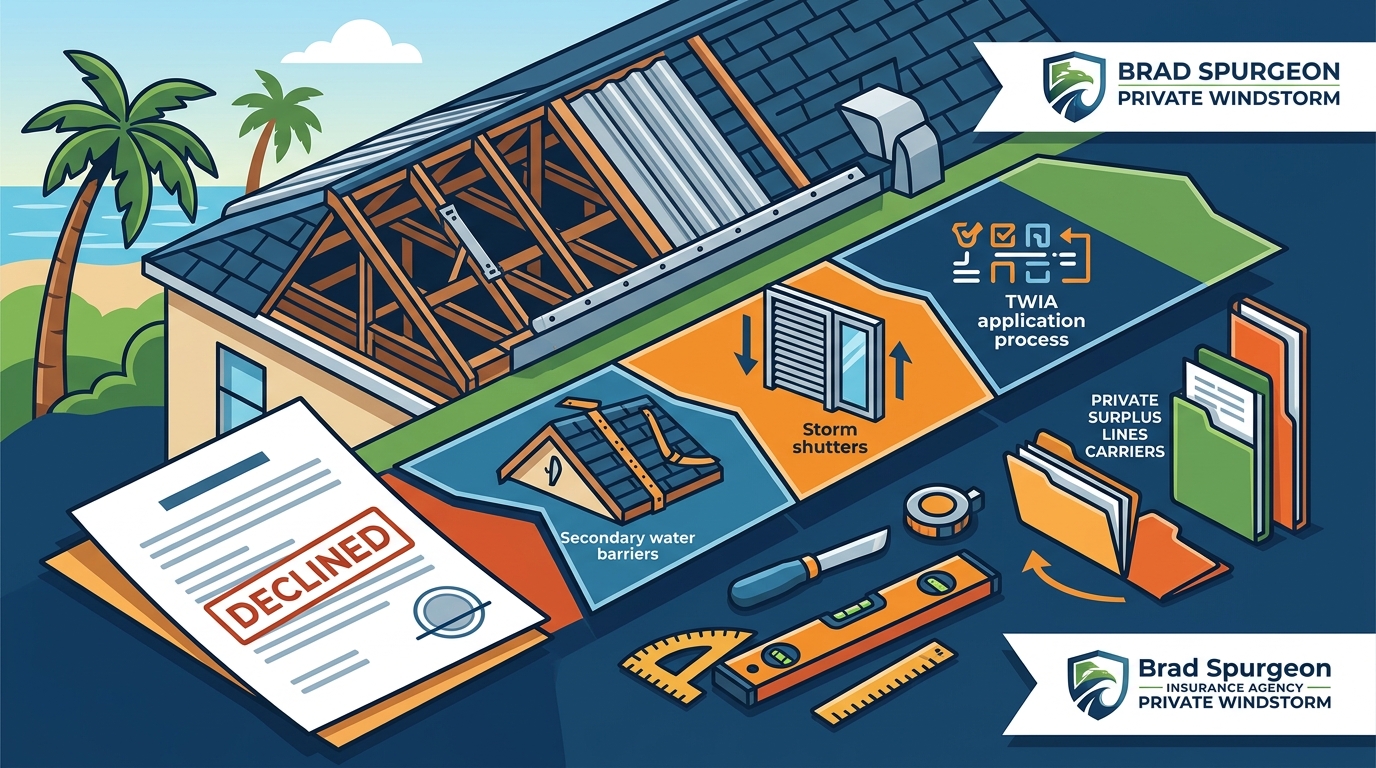
How to Get a WPI-8
For new construction or ongoing improvements, request a WPI-8 through TDI's Windstorm Inspection Program. For completed improvements that were not inspected during construction, you may qualify for a WPI-8-E, which requires certification by a licensed professional engineer.
What If Your Certificate Is Missing?
Residential properties built between 1988 and June 18, 2009 that lack certification may still qualify for TWIA coverage, but they must pay a 15% surcharge on top of the policy premium. Use TWIA's certificate lookup tool to check whether a WPI-8 or WPI-8-C is already on file for your address.
Step 2: Bring Your Property Into Insurable Condition
An insurable condition is a property state in which the structure is in good repair, free of unrepaired damage and hazardous conditions, as defined by TWIA underwriting guidelines. Even with a valid WPI-8, a home showing visible damage or deferred maintenance will be declined.
Address these items before reapplying:
- Repair or replace damaged roofing, siding, and windows.
- Remove debris, dead trees, or hazardous materials near the structure.
- Fix any code violations flagged in a previous inspection.
TWIA regularly inspects properties as part of its underwriting process, so cutting corners will only lead to another rejection. For guidance on when and where you need windstorm coverage, review your regional risk profile first.
Step 3: Apply Through TWIA as a Last Resort
The Texas Windstorm Insurance Association (TWIA) is a state-created insurer of last resort for homeowners who cannot obtain windstorm and hail coverage from private carriers. To be eligible, your property must meet several criteria:
- Located in one of the 14 first-tier coastal counties or the designated portion of Harris County east of Highway 146.
- Denied coverage by at least one authorized insurer actively writing wind and hail policies in the area.
- Certified with a valid WPI-8, WPI-8-E, or WPI-8-C.
- Maintained in an insurable condition with no unrepaired damage.
As of December 31, 2025, TWIA insured approximately 284,846 properties with roughly $126.5 billion in total insured value. Texas City sits in Galveston County, one of those 14 first-tier counties, so local homeowners are eligible by location.
Step 4: Explore Private Windstorm Carriers
TWIA is not your only path. Brad Spurgeon Insurance Agency now offers windstorm coverage through two private companies in addition to home policies that include windstorm protection. Private carriers may offer more flexible underwriting, broader coverage options, and potentially lower premiums than the state pool.
An independent agent can shop excess and surplus (E&S) lines markets on your behalf. These insurers specialize in properties that fall outside standard-market appetite, making them a strong option after multiple rejections.
Step 5: Secure Required Flood Insurance
If your property is in flood zones V, VE, or V1-30 and was constructed or altered on or after September 1, 2009, TWIA requires proof of active flood insurance through the National Flood Insurance Program (NFIP) or a private flood carrier. Failing to carry flood coverage in these zones will disqualify your windstorm application, regardless of every other requirement being met.
Learn more about surprising exclusions in flood insurance so you are not caught off guard at claim time.
TWIA vs. Private Windstorm Coverage at a Glance
| Feature | TWIA | Private Windstorm Carrier |
|---|---|---|
| Eligibility | Must be denied by at least one insurer; 14 coastal counties + Harris Co. east of Hwy 146 | Varies by carrier; broader geographic acceptance |
| WPI-8 Required | Yes (with limited exceptions) | Often yes, but some E&S carriers are more flexible |
| Flood Insurance Required | Yes, for certain flood zones | Depends on carrier underwriting |
| Coverage Type | Wind and hail only (monoline) | Wind and hail; some bundle with homeowners |
| Deductible Structure | Percentage-based, 1%-5% of dwelling limit | Percentage or flat dollar amount |
| Rate Setting | Regulated by TDI; 2026 rate freeze in effect | Market-driven; may be higher or lower |
Key Takeaways
- A windstorm insurance rejection does not mean your property is permanently uninsurable.
- The WPI-8 Certificate of Compliance is the single most important document for eligibility.
- TWIA serves as the insurer of last resort for properties in Texas's 14 first-tier coastal counties.
- Private windstorm carriers offer an alternative path, sometimes with more flexible terms.
- Properties must be maintained in good repair with no unrepaired damage to qualify.
- Flood insurance may be a prerequisite for windstorm coverage in certain FEMA-designated zones.
- Working with a local independent agent familiar with coastal underwriting significantly improves approval odds.
Frequently Asked Questions
What is TWIA?
TWIA is the Texas Windstorm Insurance Association, a state-created insurer of last resort that provides wind and hail coverage to property owners in designated coastal areas who cannot find coverage in the private market.
What is a WPI-8 certificate?
A WPI-8 is a Certificate of Compliance issued by the Texas Department of Insurance. It confirms that a property meets applicable windstorm building codes and is eligible for windstorm coverage.
Can I get windstorm insurance without a WPI-8?
In limited cases, yes. Homes built between 1988 and June 18, 2009 without certification may qualify for TWIA coverage with a 15% premium surcharge. Some private E&S carriers may also have different requirements.
What counties does TWIA cover?
TWIA covers all 14 first-tier coastal counties: Aransas, Brazoria, Calhoun, Cameron, Chambers, Galveston, Jefferson, Kenedy, Kleberg, Matagorda, Nueces, Refugio, San Patricio, and Willacy, plus parts of Harris County east of Highway 146.
Do I need flood insurance to qualify for a windstorm policy?
If your property is in flood zones V, VE, or V1-30 and was built or altered after September 1, 2009, TWIA requires proof of active NFIP or private flood insurance before issuing a windstorm policy.
How many rejections do I need before applying to TWIA?
You need at least one denial from an authorized insurer actively writing or renewing windstorm and hail coverage in the designated area. Multiple rejections strengthen your case but are not required.
Are private windstorm policies cheaper than TWIA?
It depends on the property. Some private carriers offer competitive or lower rates with broader coverage. An independent agent can compare both options side by side for your specific situation.
Does Brad Spurgeon Insurance Agency offer private windstorm options?
Yes. Brad Spurgeon Insurance Agency offers windstorm coverage through two private companies as well as home policies that include windstorm protection, in addition to helping clients access TWIA.
Get Help Qualifying for Windstorm Insurance Today
If you have been rejected for windstorm insurance and are not sure what to do next, Brad Spurgeon Insurance Agency in Texas City can help. We specialize in windstorm insurance solutions for Gulf Coast homeowners and can guide you through WPI-8 verification, TWIA applications, and private-market alternatives. Call us at (409) 945-4746 or request a free consultation to start the process.