
Homeowners in high-risk coastal regions face a complex insurance landscape where standard policies often exclude wind damage. This exclusion forces residents to seek specialized coverage through either private carriers or state-backed entities. According to recent market analysis, limited reinsurance availability is significantly hindering primary insurance availability, particularly for higher-risk coverages where insurers rely heavily on reinsurance to manage catastrophic exposure. Understanding the structural differences between these two options is critical for ensuring your property remains protected against severe weather events. (Facts Statistics Homeowners) (Home Flood amp Windstorm)
Underwriting Philosophy and Risk Selection
The most fundamental difference lies in how each entity evaluates risk. Private windstorm insurers operate as for-profit or mutual companies that must balance risk with profitability. They utilize sophisticated actuarial models to assess the specific vulnerability of a home. Windstorm insurance provides coverage for property damage caused by wind and hail, which is typically excluded from standard homeowners policies. If a property fails to meet strict construction codes, such as having a roof installed after 2008 with proper hurricane straps, private carriers may decline coverage or charge exorbitant premiums. (Windstorm and Hail)
In contrast, state-run pools, often referred to as beach and windstorm plans, function as insurers of last resort. Their mandate is to provide coverage to residents who cannot find it in the private market. This means they accept risks that private insurers reject. However, this acceptance comes with stricter eligibility requirements regarding the age and condition of the home. For a deeper understanding of how these residual markets operate, you can review the facts on homeowners insurance provided by the Insurance Information Institute. (Windstorm and Hail)
Eligibility Criteria
Private markets often require a "wind-free" claim history for the past three to five years. State pools may have more lenient claim history requirements but enforce rigorous building code compliance. In Texas, for example, the Texas Windstorm Insurance Association (TWIA) requires properties to be located within specific coastal counties and meet strict construction standards to qualify for coverage.
Coverage Limits and Policy Structure
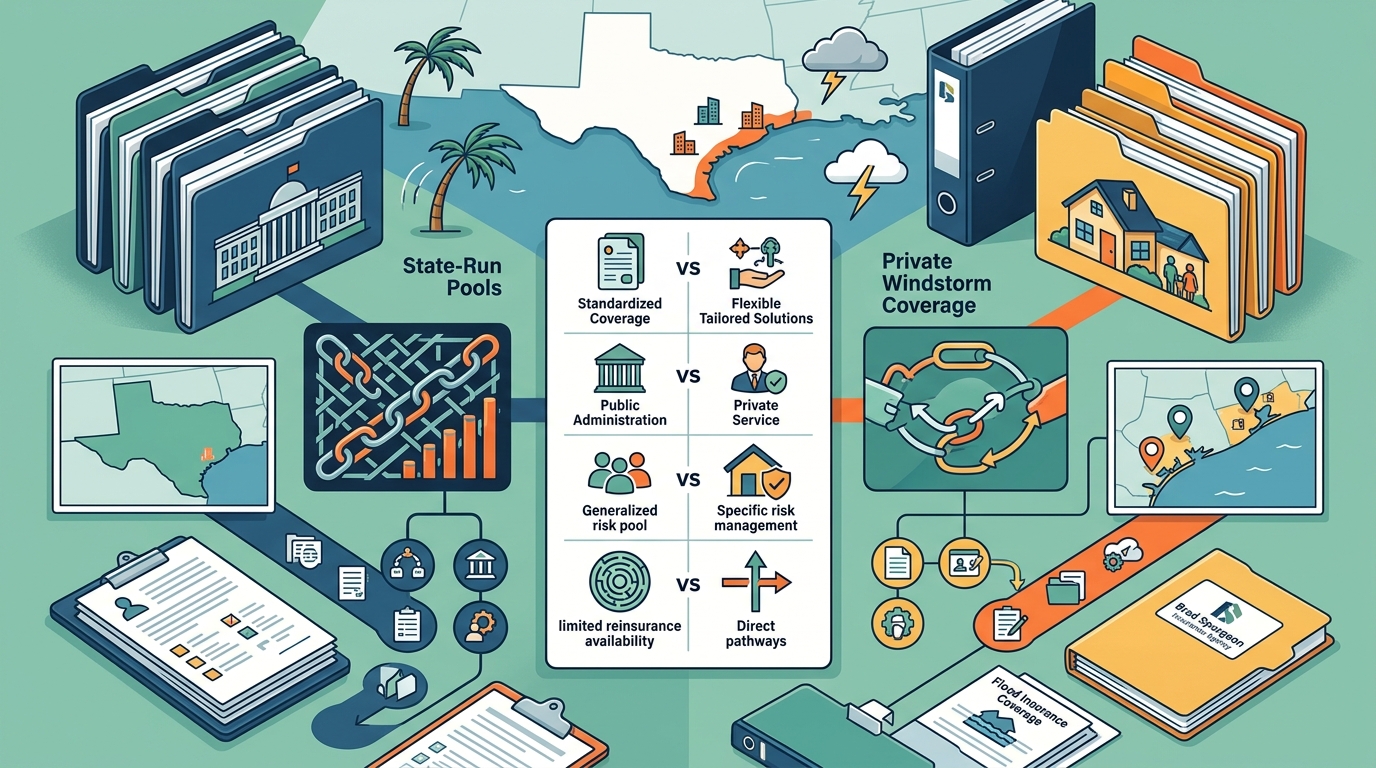
Private windstorm policies generally offer higher coverage limits and more flexible policy structures. They can tailor coverage to include additional living expenses, code upgrade coverage, and replacement cost value without the caps often seen in state-run pools. Flood insurance provides coverage for property damage caused by flooding, which is distinct from windstorm damage and not included in standard policies. Many homeowners mistakenly believe their windstorm policy covers flood damage, leading to significant financial gaps after a storm.
State-run pools typically have statutory caps on coverage amounts. For instance, TWIA has a maximum coverage limit of $30 million for residential properties. While this is substantial, it may be insufficient for high-value coastal homes. Private insurers can offer higher limits, often up to $1 million or more, depending on the carrier's risk appetite and the property's value.
Policy Endorsements
Private carriers often allow for various endorsements that enhance coverage, such as extended replacement cost or guaranteed replacement cost. State pools usually offer a more standardized set of coverages with fewer optional add-ons. This lack of flexibility can be a significant drawback for homeowners with unique architectural features or high-value contents.
Pricing Models and Premium Stability
Pricing in the private market is dynamic and influenced by global reinsurance costs, catastrophe modeling, and local risk assessments. Premiums can fluctuate significantly year to year based on the insurer's loss experience. According to industry data, the cost of insurance is rising due to increased frequency and severity of weather events. This volatility can make budgeting difficult for homeowners.
State-run pools often use a more standardized rating system based on location, construction type, and age. While this can provide some stability, it may not accurately reflect the individual risk profile of a home. For example, a well-maintained home with a new roof might pay the same premium as a neighboring home with an older roof if they are in the same risk zone. This lack of individualized pricing can be unfair to homeowners who have invested in risk mitigation.
Discount Opportunities
Private insurers frequently offer discounts for storm shutters, reinforced roofs, and claims-free history. State pools may offer limited discounts, such as those for compliant construction. It is essential to compare the net premium after all applicable discounts to determine the true cost of coverage.
Claims Processing and Customer Service
Customer service and claims handling are critical differentiators. Private insurers often have dedicated claims teams and faster processing times for straightforward claims. They may also offer advanced digital tools for policy management and claims submission. Home Insurance protects your property and belongings from risks like fire, theft, and natural disasters. When a windstorm occurs, the ability to quickly access your insurer for guidance can reduce stress and accelerate recovery.
State-run pools, particularly after major catastrophes, can experience significant backlogs in claims processing. The sheer volume of claims following a hurricane can overwhelm their resources, leading to delays in payment. Additionally, the claims process may be more bureaucratic, requiring extensive documentation and inspections before coverage is approved.
Transparency and Communication
Private carriers often provide more transparent communication regarding claim status and estimated payout times. State pools may have less frequent updates, leaving homeowners in the dark during the critical post-storm period. This lack of communication can exacerbate the financial and emotional strain of a disaster.
Financial Solvency and Market Stability
The financial health of the insurer is paramount. Private windstorm carriers are rated by agencies like A.M. Best and Standard & Poor's, providing transparency into their financial strength. According to the Office of Financial Research, limited reinsurance availability will hinder primary insurance availability, especially for higher-risk coverages. This highlights the importance of choosing a private carrier with strong reinsurance backing.
State-run pools are backed by the full faith and credit of the state, which provides a high degree of solvency assurance. However, this also means that taxpayers may ultimately bear the burden if the pool faces severe financial distress. In Florida, the collapse of Citizens Property Insurance Corp. has led to significant political and financial debates about the future of state-backed insurance.
Long-Term Viability
While state pools offer stability, their long-term viability is threatened by rising climate risks and political pressure. Private markets, while volatile, are more adaptable to changing risk landscapes through product innovation and risk transfer mechanisms.
Comparison Summary
| Feature | Private Windstorm Coverage | State-Run Insurance Pool |
|---|---|---|
| Primary Goal | Profit and Risk Management | Provide Coverage of Last Resort |
| Coverage Limits | High (Often $1M+) | Statutory Caps (e.g., $30M) |
| Pricing | Dynamic, Individualized | Standardized, Zone-Based |
| Eligibility | Strict Underwriting | More Lenient, Code-Compliant |
| Claims Speed | Generally Faster | Can Be Delayed Post-Catastrophe |
| Financial Backing | Reinsurance and Capital | State Taxpayer Backing |
Key Takeaways
- Private carriers offer higher limits and more flexible policies but require strict underwriting compliance.
- State-run pools serve as a safety net for high-risk properties but have statutory coverage caps.
- Premiums in the private market are volatile, while state pools offer more standardized pricing.
- Claims processing can be slower in state pools after major catastrophes due to volume.
- Financial solvency is backed by reinsurance for private carriers and state credit for pools.
- Eligibility for state pools often requires meeting specific building code standards.
- Brad Spurgeon Insurance Agency has served the Texas Gulf Coast since 1986, providing expert guidance on these complex choices. (Facts Statistics Homeowners)
Frequently Asked Questions
What is the main difference between private windstorm and state-run pools?
Private windstorm insurers focus on risk management and profitability, offering higher limits and flexible policies. State-run pools act as insurers of last resort, providing coverage to those who cannot find it in the private market, often with statutory caps.
Can I get windstorm coverage if my home is older?
Yes, but it may be more difficult. Private insurers may require roof inspections or upgrades. State-run pools like TWIA have specific requirements for older homes, often mandating compliance with current building codes to qualify.
Are state-run pools financially stable?
State-run pools are backed by the full faith and credit of the state, which provides strong solvency assurance. However, they can face financial strain after major catastrophes, potentially leading to premium increases or policy changes.
How do I know if I need a separate windstorm policy?
If you live in a coastal area, your standard homeowners policy likely excludes wind damage. You will need a separate windstorm policy or a windstorm endorsement. Flood insurance provides coverage for property damage caused by flooding, which is distinct from windstorm damage.
What is the WPI-8 form?
The WPI-8 is a standard policy form used by the Texas Windstorm Insurance Association (TWIA). It outlines the specific terms, conditions, and exclusions of windstorm and hail coverage in Texas.
Do state-run pools offer discounts?
Some state-run pools offer discounts for compliant construction, such as roofs installed after specific dates. Private insurers often offer a wider range of discounts, including claims-free and mitigation discounts.
How long does it take to file a claim with a state pool?
Claims processing times can vary significantly. During normal periods, it may be relatively quick. However, after a major hurricane, backlogs can delay processing for weeks or months.
Get Your Custom Quote
Navigating the choice between private windstorm coverage and state-run pools requires expert guidance. At Brad Spurgeon Insurance Agency, we specialize in helping Texas Gulf Coast homeowners secure the right protection. Our team understands the nuances of the local market and can help you find a policy that fits your needs and budget. Contact us today to schedule a free consultation and ensure your home is properly protected.
Get a Home Insurance Quote | Get a Windstorm Insurance Quote | Get a Flood Insurance Quote