
Being turned down for windstorm coverage by one insurer is frustrating. Being rejected by two or three feels like a dead end. But multiple denials do not mean you are uninsurable. There is a clear, sequential path back to coverage—and it starts with understanding exactly why you were rejected and what you can do to change the equation.
Key Takeaways
- Rejection letters contain specific denial reasons that map directly to corrective actions you can take.
- A certified wind mitigation inspection can reduce premiums by 3–55% and make your home far more attractive to underwriters.
- State-run insurers of last resort—such as FAIR Plans, wind pools, and Citizens Property Insurance—exist in 33 states specifically for homeowners who cannot find private coverage.
- Physical upgrades like hurricane straps, impact-resistant windows, and hip-roof conversions directly address the structural deficiencies insurers cite most often.
- Surplus lines carriers and specialty windstorm insurers provide additional private-market options beyond standard carriers.
Step 1: Decode Every Rejection Letter
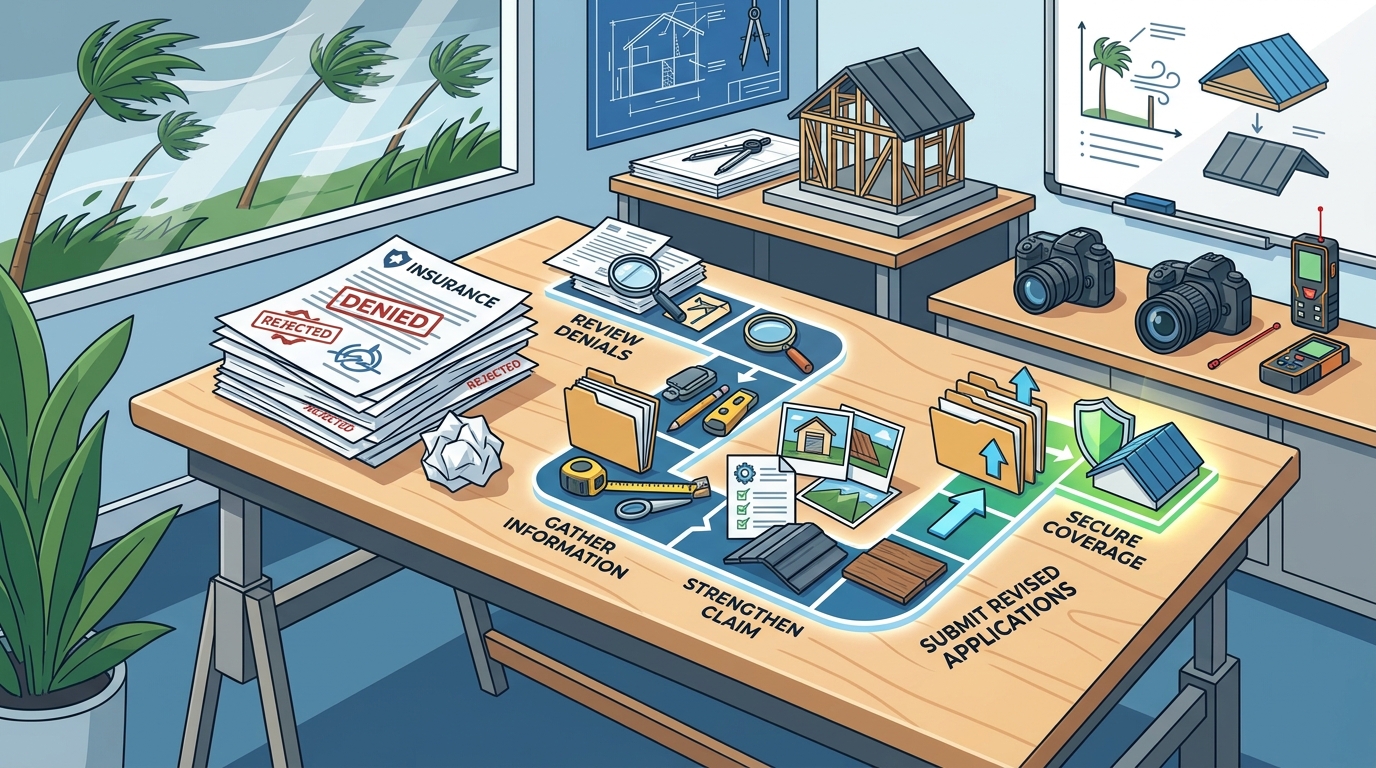
Before you spend money on upgrades or applications, you need to understand exactly what each insurer objected to. Denial reasons are not random; they follow underwriting guidelines that you can address methodically.
Common Reasons Insurers Deny Windstorm Coverage
- Roof age or condition: Insurers frequently argue that shingles were already deteriorating due to age rather than storm exposure. If your roof is more than 10 to 15 years old, adjusters are especially likely to cite deterioration.
- Lack of wind-resistant construction features: Homes without hurricane straps, impact-resistant openings, or proper roof-deck attachment are considered high-risk.
- Property location in a high-risk wind zone: Coastal and beachfront properties within 1,500 feet of a major body of water face the most limited private-market options.
- Pre-existing damage or deferred maintenance: If an insurer believes you have not maintained your property properly, they may deny coverage outright.
- Claims history: Multiple prior wind claims or an excessive number of paid claims can trigger non-renewal or rejection.
Pull out each rejection letter and create a simple spreadsheet listing the insurer name, date, and each specific reason cited. This document becomes your action plan.
Step 2: Get a Certified Wind Mitigation Inspection
A wind mitigation inspection is the single most impactful step you can take to improve your insurability. This is a specialized assessment that evaluates how well your home can withstand hurricane-strength winds—and it produces a formal report that insurers use to determine eligibility and pricing.
What the Inspector Evaluates
The inspection focuses on structural features that directly influence wind performance:
- Roof-to-wall connections: Are hurricane clips or straps present? The type of connector is one of the highest-value credits.
- Roof deck attachment: How is the plywood secured to the trusses? Larger nails at closer spacing earn better ratings.
- Roof geometry: Hip roofs receive significantly better ratings than gable roofs because field testing shows gable roofs receive up to 40% more wind pressure.
- Roof covering compliance: Whether materials meet current Florida Building Code or equivalent standards.
- Opening protection: Impact-resistant windows, doors, and hurricane shutters.
- Secondary water resistance (SWR): Self-adhering underlayment between the roof covering and deck that prevents water intrusion if shingles are lost.
Practical Details
In Florida, the inspection produces a standardized form (OIR-B1-1802) that is submitted directly to your insurance provider. The entire process usually takes 30 to 90 minutes and costs between $75 and $150. The report is valid for up to five years provided no material changes are made to the structure.
A positive wind mitigation report can save you anywhere from 3% to 55% on the wind portion of your home insurance premium. More importantly, for homeowners who have been rejected, this report can be the difference between “uninsurable” and “approved.”
Who Can Perform the Inspection
Florida law limits windstorm mitigation inspections to licensed home inspectors, general contractors, building contractors, architects, engineers, and building inspectors with current credentials. Always verify your inspector’s license through your state’s official licensing website before scheduling.
Step 3: Make Targeted Structural Upgrades
If your wind mitigation inspection reveals deficiencies—and if those deficiencies match the reasons insurers rejected you—targeted upgrades can transform your risk profile.
Highest-Impact Improvements
| Upgrade | Typical Cost Range | Insurance Impact |
|---|---|---|
| Hurricane straps/clips (roof-to-wall connectors) | $1,500–$3,500 | One of the largest single credits on the mitigation form |
| Impact-resistant windows and doors | $5,000–$25,000+ | Significant premium discount; satisfies opening-protection requirement |
| Re-roofing with code-compliant materials | $8,000–$20,000+ | Addresses roof age objections; homes re-roofed after March 2002 receive the best credits in Florida |
| Secondary water resistance underlayment | $1,000–$3,000 (during re-roof) | Qualifies for SWR credit; relatively inexpensive when added during a re-roof |
| Hurricane shutters or panels | $1,500–$8,000 | Alternative to impact-resistant windows at lower cost |
Financial Assistance Programs
Some states offer grant programs to help offset the cost of wind mitigation improvements. Florida’s My Safe Florida Home program, for example, provides matching grants of $2 for every $1 a homeowner contributes, covering two-thirds of costs up to $10,000. Low-income homeowners may qualify for full grants without matching requirements.
After completing improvements, schedule a follow-up wind mitigation inspection so the upgrades are formally documented and can be submitted to prospective insurers.
Step 4: Reapply to the Private Market Strategically
With a clean mitigation report in hand, you are in a fundamentally different position than when you were first rejected. Here is how to maximize your chances:
Work with an Independent Insurance Agent
Independent agents represent multiple carriers and can shop your updated risk profile across the broadest possible market. They know which companies are actively writing windstorm coverage in your area and which underwriters are most receptive to mitigation improvements.
Consider Surplus Lines Carriers
If standard admitted carriers still will not write your risk, surplus lines insurance covers unique risks like hard-to-insure houses. Be aware that surplus lines insurance has fewer consumer protections than typical home insurance, but it fills a critical gap for properties that the standard market will not touch.
Separate Your Policies
In many coastal markets, the practical solution is a split-policy approach: one carrier handles fire, theft, liability, and non-wind water damage, while a second carrier (or state program) handles windstorm. The two policies have separate premiums, separate deductibles, and separate claims processes, but together they provide complete coverage.
Step 5: Access State-Run Last-Resort Programs
If you have exhausted the private market, every coastal state offers some form of government-backed wind coverage. These programs exist specifically for homeowners in your situation.
FAIR Plans
FAIR (Fair Access to Insurance Requirements) plans are state-mandated property insurance pools available in 33 states, the District of Columbia, and Puerto Rico. They are financially backed by private insurers operating in the state and provide basic property coverage when no private insurer will write a policy.
Important considerations: FAIR plan coverage is typically more limited and more expensive than private insurance. This is intentional—the higher cost encourages homeowners to transition back to the private market as soon as possible.
Beach and Windstorm Plans
Several states operate dedicated windstorm pools separate from FAIR plans. These provide wind-only coverage in designated high-risk coastal zones. Examples include:
- Texas Windstorm Insurance Association (TWIA): Sells wind and hail coverage for coastal residents who have been turned down by private carriers. You may need a home inspection by an engineer or windstorm inspector, and depending on your location, flood insurance may be a prerequisite.
- Mississippi Windstorm Underwriting Association (MWUA): Provides windstorm and hail coverage in coastal counties.
- North Carolina Coastal Property Insurance Pool (NCIUA): Covers essential property and wind in the coastal “Beach Area” pool.
Citizens Property Insurance (Florida)
Citizens Property Insurance Corporation is Florida’s state-backed insurer of last resort. It was created in 2002 to provide both windstorm and general property insurance for homeowners who cannot obtain coverage elsewhere. Under Florida law, Citizens may write a new insurance policy only if no comparable private market coverage is available or comparable private market policy premiums are more than 15% higher than a comparable Citizens policy.
Citizens offers both full homeowners (HO-3) policies and wind-only policies. You can only purchase a Citizens policy through a Citizens-appointed insurance broker.
Step 6: Maintain Your Insurability Long-Term
Getting coverage is only half the battle. Keeping it requires ongoing effort:
- Document everything: Keep current photos of your property, store receipts for improvements, and maintain home repair records.
- Schedule re-inspections: Wind mitigation reports expire after five years. If you make improvements during that period, get a new inspection to unlock additional credits.
- Report damage promptly: Most insurers have strict timelines for reporting damage. Delays can lead to denial even when the claim is valid.
- Shop annually: The windstorm insurance market shifts every year. Carriers enter and exit markets, and your improved risk profile may qualify you for private coverage that was unavailable when you first applied.
- Maintain your roof and structure: Regular upkeep eliminates the “deferred maintenance” objection that insurers commonly use to deny coverage or claims.
Real-World Scenario: From Three Rejections to Full Coverage
Consider a homeowner in a Florida coastal county with a 2001-built home featuring a gable roof, no hurricane shutters, and toe-nailed roof-to-wall connections. Three private carriers rejected the application, citing roof age, inadequate opening protection, and insufficient roof-to-wall attachment.
The homeowner’s recovery path:
- Obtained a wind mitigation inspection ($100) documenting the specific deficiencies.
- Re-roofed with FBC-compliant shingles and added secondary water resistance during the project (~$14,000). Applied for a My Safe Florida Home grant covering $9,333 of the cost.
- Installed hurricane straps (~$2,500) and accordion hurricane shutters (~$4,000).
- Obtained a follow-up wind mitigation inspection documenting all improvements.
- An independent agent shopped the updated profile. Two private carriers offered quotes; one was competitive. The homeowner secured a private windstorm policy at a premium 35% lower than what Citizens would have charged.
Total out-of-pocket after grant: approximately $11,167. Annual premium savings versus a Citizens wind-only policy: approximately $2,800. Payback period: roughly four years—plus a more resilient home.
Frequently Asked Questions
Can I still get windstorm insurance after being rejected by multiple companies?
Yes. Multiple rejections do not make you permanently uninsurable. State-run programs like FAIR Plans, wind pools, and Citizens Property Insurance exist specifically for homeowners who cannot find private coverage. Additionally, making structural improvements and obtaining a wind mitigation inspection can qualify you for private-market policies that previously rejected you.
What is a wind mitigation inspection and how much does it cost?
A wind mitigation inspection evaluates your home’s structural features that resist wind damage, including roof-to-wall connections, roof deck attachment, roof geometry, and opening protection. The inspection typically costs $75 to $150 and takes 30 to 90 minutes. The resulting report can unlock insurance premium discounts of 3% to 55% on the wind portion of your policy.
What is a FAIR Plan and how do I apply?
A FAIR Plan is a state-mandated insurance pool that provides basic property coverage to homeowners who have been unable to obtain insurance through private carriers. FAIR plans exist in 33 states plus the District of Columbia. To apply, you typically need proof of rejection from private insurers and must work with a licensed insurance agent. Coverage is generally more limited and more expensive than private insurance.
What home improvements help me qualify for windstorm insurance?
The most impactful improvements include installing hurricane straps or clips for roof-to-wall connections, replacing windows and doors with impact-resistant versions, re-roofing with code-compliant materials, adding secondary water resistance underlayment, and installing hurricane shutters. A hip roof also performs significantly better than a gable roof, receiving up to 40% less wind pressure.
How is Citizens Property Insurance different from regular home insurance?
Citizens Property Insurance Corporation is Florida’s state-backed, not-for-profit insurer of last resort. It provides coverage to homeowners who cannot obtain insurance in the private market or whose private-market quotes exceed Citizens’ rates by more than 20%. Citizens policies are generally more limited in coverage and may carry higher premiums than competitive private-market policies. You must apply through a Citizens-appointed broker.
How long does a wind mitigation inspection report remain valid?
A wind mitigation inspection report is generally valid for five years, provided no material changes are made to the structure. If you replace your roof or make other mitigation improvements during that period, you should get a new inspection to ensure you receive all available premium discounts.