
Homeowners along the Texas Gulf Coast face unique peril profiles that standard policies simply cannot address. Windstorm and flood insurance are distinct coverage types that require separate evaluation because standard homeowners policies explicitly exclude flood damage and often limit or exclude windstorm coverage in high-risk coastal zones. With the region experiencing increasing frequency of severe weather events, understanding the specific mechanics of these policies is no longer optional. It is a financial necessity for protecting property value and ensuring recovery capability after a disaster.
Why Standard Policies Fail Coastal Homes
Many homeowners assume their standard homeowners insurance policy covers all weather-related damage. This is a dangerous misconception. Standard policies are designed for inland risks and do not account for the specific mechanical forces of coastal storms. Windstorm insurance is a specialized policy that covers damage caused by high winds, hail, and tornadoes, which are often excluded or severely limited in standard contracts.
Furthermore, flood damage is almost universally excluded from standard homeowners policies. According to the Federal Emergency Management Agency (FEMA), less than 20 percent of flood insurance policies are held by property owners outside high-risk flood zones, yet nearly 25 percent of all flood claims come from these moderate-to-low risk areas. This statistic highlights a critical gap in public understanding of risk. If your home is not in a designated flood zone, you might incorrectly assume you are safe. The data shows that water intrusion from storm surge or heavy rainfall can occur anywhere, regardless of official map designations.
Evaluating your current coverage requires a line-by-line audit. You must determine if your current carrier offers windstorm coverage or if you need a separate policy. In Texas, many major carriers have exited the windstorm market, leaving homeowners to seek specialized coverage through agencies like Brad Spurgeon Insurance Agency. Understanding the difference between a "windstorm included" home policy and a standalone windstorm policy is the first step in proper evaluation.
Windstorm Coverage Deep Dive
Windstorm insurance in Texas is governed by specific state regulations and carrier restrictions. Because the risk of catastrophic loss is so high, not all insurance companies are authorized to write windstorm coverage in coastal counties. This creates a fragmented market where homeowners must navigate multiple carriers to find adequate protection.
What Windstorm Insurance Covers
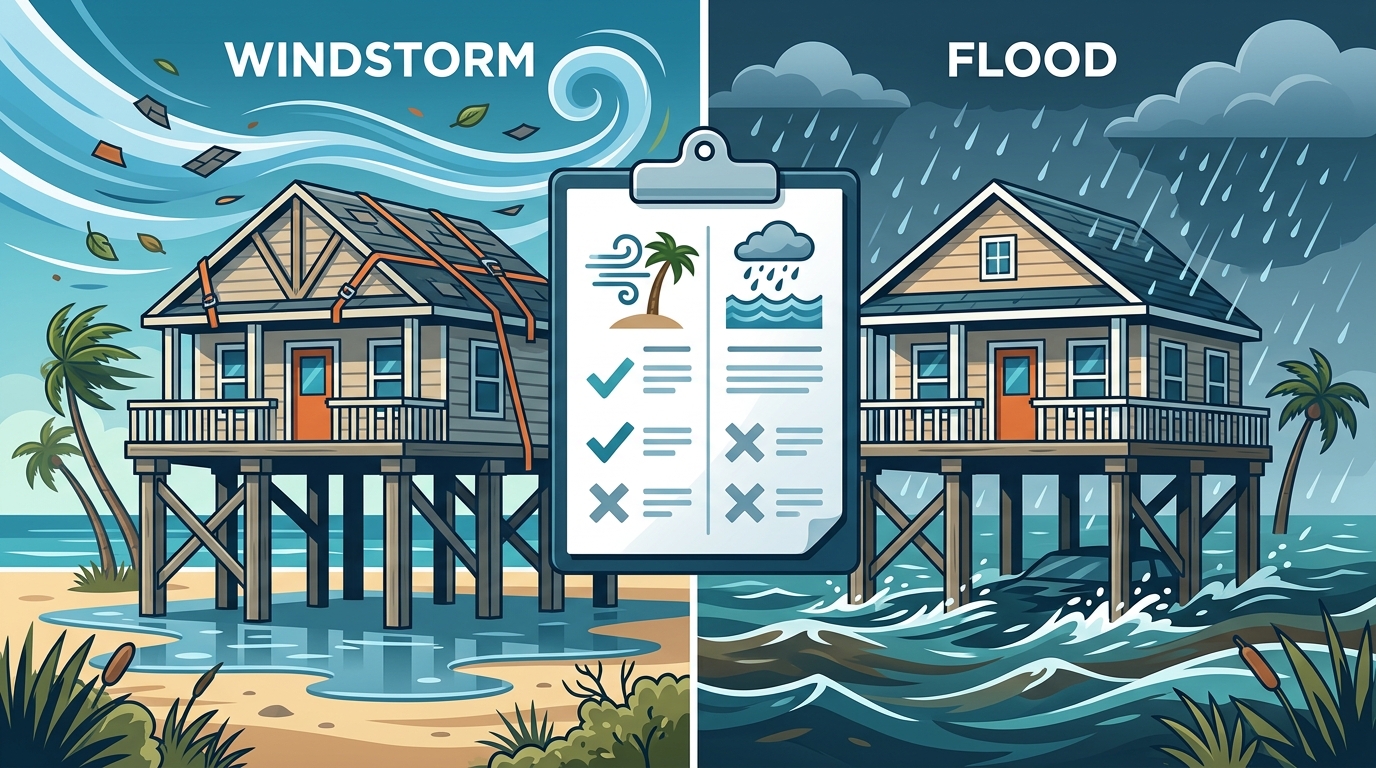
Windstorm insurance typically covers structural damage to the home, including the roof, walls, and foundation, caused by wind forces. It also covers detached structures like garages and sheds. Beyond structural damage, it often includes coverage for personal property damaged by wind, such as furniture and electronics, provided the damage is directly caused by the wind event. However, it is crucial to note that windstorm insurance does not cover flood damage. If wind drives rain into your home, the resulting water damage is typically considered flood damage, not wind damage, unless specific endorsements are in place.
The Role of the WPI-8 Policy
In Texas, the WPI-8 (Windstorm and Hail Property Insurance Policy) is the standard form used for windstorm coverage. This policy has specific deductibles and coverage limits that differ from standard homeowners policies. Homeowners must understand the WPI-8 deductible structure, which is often a percentage of the dwelling coverage limit rather than a flat dollar amount. For example, a 2 percent deductible on a $500,000 home means a $10,000 out-of-pocket cost before coverage begins. Evaluating your ability to pay this deductible is a critical part of the selection process.
For detailed guidance on understanding your specific policy documents, you can review the WPI-8 Certificate Guide provided by our agency. This resource helps demystify the complex language used in windstorm contracts.
Flood Insurance Necessity
Flood insurance is not just for those in high-risk zones. While properties in Special Flood Hazard Areas (SFHAs) are often required to carry flood insurance by mortgage lenders, those in moderate-to-low risk areas are not. However, the risk remains real. Flood insurance provides coverage for property damage caused by flooding, which is defined as a general and temporary condition of partial or complete inundation of two or more acres of normally dry land or two or more properties.
Types of Flood Coverage
There are two main types of flood insurance: standard policies through the National Flood Insurance Program (NFIP) and private flood insurance. NFIP policies have strict coverage limits, with a maximum of $250,000 for residential building coverage and $100,000 for personal property. For high-value homes in the Gulf Coast region, these limits are often insufficient. Private flood insurance offers higher limits and more flexible coverage options, but it requires careful evaluation of the carrier's financial stability and claims handling reputation.
According to the Insurance Information Institute, the average cost of flood insurance is approximately $700 per year, but this varies wildly based on location and risk. In high-risk coastal areas, premiums can exceed $2,000 annually. Evaluating the cost-benefit ratio is essential. The cost of a policy is significantly lower than the cost of rebuilding a home from scratch after a storm surge.
Understanding the 30-Day Waiting Period
One of the most critical aspects of flood insurance is the 30-day waiting period for new policies to take effect. This means you cannot purchase flood insurance the day before a storm hits. If you are evaluating your coverage options, you must act well in advance of any predicted weather events. This waiting period applies to both NFIP and most private policies. Planning ahead is the only way to ensure you are protected when disaster strikes.
Comparing Policy Options
Evaluating your options requires comparing different carriers and policy structures. The Texas Gulf Coast market is unique, with specific carriers dominating the windstorm space. Below is a comparison of the primary options available to homeowners.
| Policy Type | Coverage Scope | Best For | Key Consideration |
|---|---|---|---|
| Standalone Windstorm | Wind, hail, tornado damage only | Homeowners with separate flood coverage | Requires WPI-8 deductible understanding |
| NFIP Flood Policy | Water damage from external sources | Properties in SFHAs or with mortgage requirements | $250k building limit cap |
| Windstorm Included Home Policy | Combined wind and basic home coverage | Homeowners seeking simplified management | Check if flood is excluded |
| Private Flood Insurance | Enhanced flood coverage | High-value homes exceeding NFIP limits | Higher premiums but greater protection |
When comparing these options, consider the financial strength of the carrier. In the aftermath of a major hurricane, the ability of your insurer to pay claims quickly is paramount. Look for carriers with high AM Best ratings and a strong presence in the Texas market. Our agency partners with top-rated carriers who understand the unique needs of Gulf Coast homeowners.
Key Takeaways
- Standard policies exclude flood damage: Never assume your homeowners policy covers water intrusion from storms.
- Windstorm is specialized: Windstorm insurance in Texas often requires a separate policy or specific endorsements due to carrier restrictions.
- WPI-8 deductibles are percentage-based: Understand that your out-of-pocket cost is a percentage of your home's insured value, not a flat fee.
- Flood risk is universal: According to FEMA, 20 percent of flood claims come from moderate-to-low risk areas, not just high-risk zones.
- Act before the storm: Flood insurance has a 30-day waiting period, so evaluation and purchase must happen in advance.
- Brad Spurgeon Insurance Agency has served the Gulf Coast since 1986: Our three-generation family agency provides specialized expertise in windstorm and flood coverage.
- Private options exist: Private flood insurance offers higher limits than NFIP policies for high-value homes.
Frequently Asked Questions
Do I need flood insurance if I am not in a flood zone?
Yes, you should strongly consider it. While not always legally required, flood risk exists outside designated high-risk zones. Data indicates that a significant portion of flood claims originate from moderate-to-low risk areas, making coverage a prudent financial decision for any homeowner.
What is the difference between windstorm and homeowners insurance?
Homeowners insurance typically covers fire, theft, and liability, while windstorm insurance specifically covers damage from high winds and hail. In high-risk coastal areas, windstorm coverage is often excluded from standard homeowners policies and must be purchased separately.
How does the WPI-8 deductible work?
The WPI-8 deductible is usually a percentage of your dwelling coverage limit. For example, if your home is insured for $400,000 and you have a 2 percent deductible, you would pay the first $8,000 of windstorm damage before your insurance kicks in.
Can I get flood insurance after a hurricane warning is issued?
No. Most flood insurance policies, including those from the NFIP, have a 30-day waiting period before they become effective. You must purchase the policy before the storm warning is issued to ensure coverage is active.
What is a Windstorm Included Home Policy?
A Windstorm Included Home Policy is a specialized product offered by certain carriers that bundles windstorm coverage with standard homeowners insurance. This simplifies the process for homeowners by combining multiple coverages into one policy, though it is essential to verify that flood damage is still excluded.
How do I report a claim with Brad Spurgeon Insurance Agency?
You can report a claim by contacting our agency directly. We offer online services for reporting claims, making payments, and accessing policy documents. Visit our Report a Claim page for immediate assistance.
Does flood insurance cover personal property?
Yes, both NFIP and private flood policies offer coverage for personal property, such as furniture, clothing, and electronics. However, the coverage limits for personal property are often lower than those for the structure itself. Ensure you evaluate your personal property needs when selecting a policy.
Secure Your Coverage Today
Evaluating your windstorm and flood insurance needs is a critical step in protecting your home and financial future. The Texas Gulf Coast presents unique challenges that require specialized knowledge and tailored solutions. At Brad Spurgeon Insurance Agency, we have dedicated over three decades to helping homeowners navigate these complexities. Our team is ready to provide a free consultation to review your current coverage and identify any gaps.
Do not wait for a storm to reveal the weaknesses in your protection. Contact us today to get a quote and ensure your home is adequately covered. Visit our Home Insurance Quote page to start the process. Your peace of mind is our priority.