
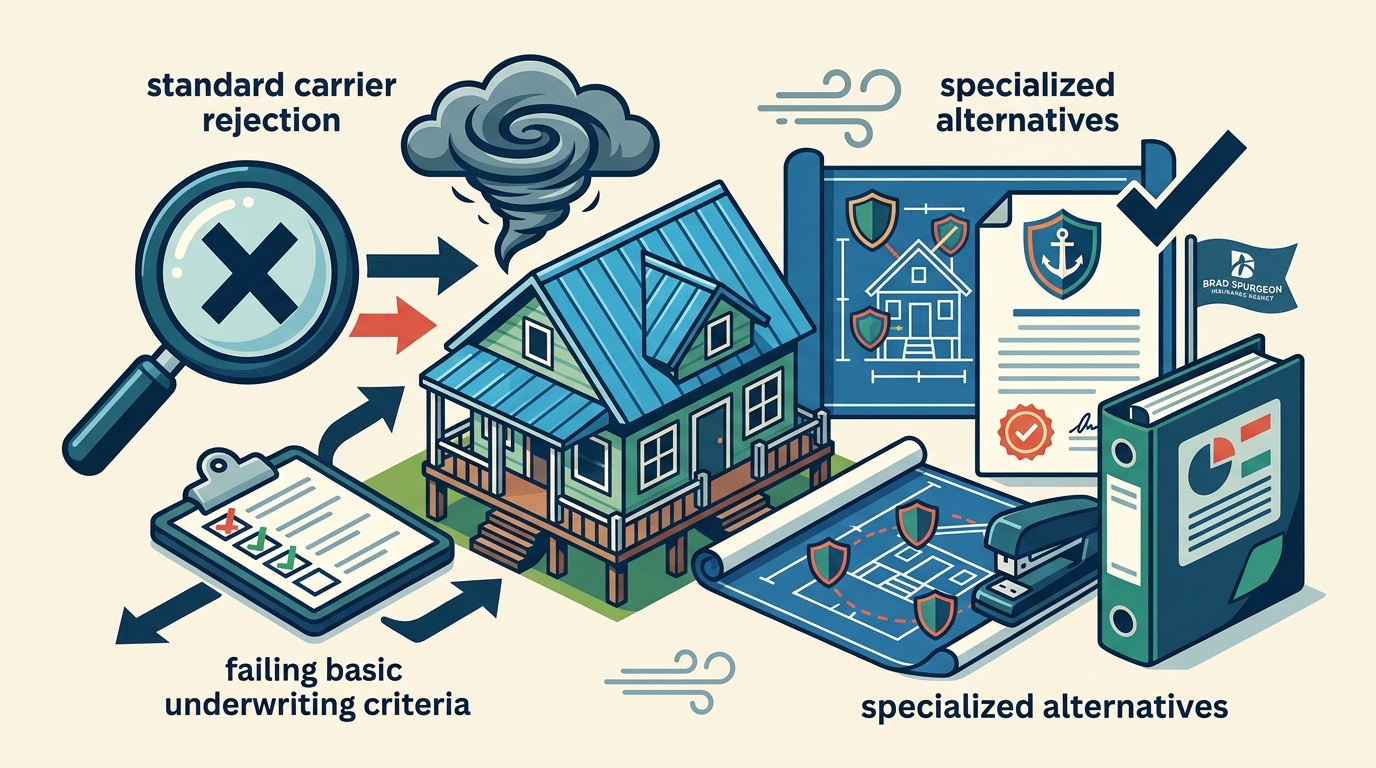
Being declined for a standard homeowners policy does not necessarily mean your Texas City property must go uninsured against hurricanes, tropical storms, tornadoes, or severe thunderstorms. In coastal Texas, wind and hail coverage may be excluded from a homeowners policy or offered only through a separate policy. A specialized windstorm solution—often obtained through the Texas Windstorm Insurance Association (TWIA) or an eligible private-market carrier—can help fill that gap.
The right approach is to determine why the property was declined, verify whether the address is in a designated windstorm area, collect construction and maintenance records, confirm inspection requirements, and coordinate windstorm coverage with your homeowners and flood policies. A local agency such as Brad Spurgeon Insurance Agency can help evaluate the property and identify available options before the next storm threatens the Gulf Coast.
The Short Answer: Use a Separate Windstorm Policy or a Specialty Carrier
If a standard homeowners insurer will not provide wind and hail coverage, ask an insurance agent to review two possible routes:
- Private windstorm coverage: Some specialty or regional carriers may insure coastal properties that do not fit the underwriting rules of a traditional homeowners company.
- TWIA coverage: TWIA serves as an insurer of last resort for eligible property owners in Texas coastal areas who cannot obtain wind and hail coverage from the private market.
In Texas, coastal homeowners commonly use separate policies: one policy for general homeowners risks such as fire, theft, and liability; a windstorm policy for covered wind and hail losses; and, when needed, a flood policy for rising-water damage. The Texas Department of Insurance explains that most coastal home policies may not cover wind and hail, while most homeowners policies do not cover flood damage. ([tdi.texas.gov](https://www.tdi.texas.gov/tips/what-is-windstorm-insurance.html?utm_source=openai))
These policies are not interchangeable. A windstorm policy generally does not replace flood insurance, and flood insurance generally does not replace windstorm coverage. Reviewing all three contracts together is important because the same hurricane can produce wind damage, storm surge, and rain-related water damage under different policy definitions.
Why a Standard Homeowners Insurer May Decline Your Property
A denial is usually connected to underwriting rules rather than a single universal defect. The insurer may be concerned about the property’s location, construction history, roof condition, prior losses, occupancy, replacement cost, or the absence of documentation.
Coastal location and wind exposure
Properties near Galveston Bay, the Gulf Coast, or other designated catastrophe areas face greater hurricane and windstorm exposure. Texas City and other Galveston County communities are within the coastal area where homeowners may need a separate wind and hail policy. TWIA’s designated catastrophe area includes all of Galveston County and 13 other first-tier coastal counties, along with specified areas of Harris County east of Highway 146. ([tdi.texas.gov](https://www.tdi.texas.gov/general/texas-homeowners-insurance-market-overview.html?utm_source=openai))
Roof condition or incomplete roof records
Insurers may request the roof’s installation date, material, remaining useful life, inspection results, photographs, or evidence of repairs. An older roof is not automatically uninsurable through every market, but missing records, visible deterioration, unrepaired damage, or undocumented work can make placement more difficult.
Older construction or undocumented improvements
Older properties may not have documentation showing how roof-to-wall connections, framing, openings, foundations, or other components were built. Additions, re-roofing, repairs, and renovations can also create eligibility questions when permits, engineering documents, or windstorm certificates cannot be located.
Prior claims, vacancy, or unusual property characteristics
Repeated wind or water claims, extended vacancy, unusual architectural features, elevated replacement costs, detached structures, coastal exposure, or commercial activity at the residence may cause a standard carrier to decline or limit coverage. The reason for the declination should be obtained in writing because it helps an agent target the next market efficiently.
Four Coverage Paths to Explore After a Homeowners Declination
1. Ask whether wind and hail were excluded—not whether the entire property is uninsurable
Sometimes a carrier will write a homeowners policy without wind and hail coverage. That policy can still provide important protection for covered causes of loss such as fire, theft, and liability, while a separate windstorm policy supplies the missing weather protection. Read the exclusions, declarations page, endorsements, and deductible provisions carefully before assuming you have wind coverage.
2. Shop private specialty markets
Some private carriers focus on coastal or higher-risk properties. A specialty-market quote may offer different deductibles, limits, exclusions, inspection requirements, or claims procedures than a TWIA policy. Availability depends on the property, address, construction features, loss history, and current underwriting capacity.
3. Apply for TWIA through an agent
TWIA is commonly accessed through a local insurance agent. To qualify, an applicant generally must own property in TWIA’s service area, demonstrate that private wind and hail coverage was unavailable or declined, and satisfy applicable construction or inspection requirements. The Texas Department of Insurance states that TWIA cannot issue a policy when a hurricane is in the Gulf of Mexico, so waiting until a storm is approaching can leave a property without an available option. ([tdi.texas.gov](https://www.tdi.texas.gov/tips/what-is-windstorm-insurance.html?utm_source=openai))
4. Address the underlying property issue
If the obstacle is a damaged roof, missing permit, unverified addition, or failed inspection, correcting the issue may expand the available market. Before starting work, ask how the proposed repair or replacement will affect windstorm eligibility. Repairs performed without the required documentation may create additional insurance problems later.
How TWIA Eligibility Generally Works in Coastal Texas
TWIA eligibility is based on more than the property’s address. The property must be within the designated service area, the applicant must meet the availability requirements, and the structure must satisfy applicable windstorm construction and certification rules.
Confirm the address
TWIA’s service area includes the 14 first-tier coastal counties: Aransas, Brazoria, Calhoun, Cameron, Chambers, Galveston, Jefferson, Kenedy, Kleberg, Matagorda, Nueces, Refugio, San Patricio, and Willacy. Certain Harris County locations east of Highway 146 are also included, but the Harris County rules are tied to specified city limits. An agent should verify the exact address rather than relying only on a general description such as “near the coast.” ([tdi.texas.gov](https://www.tdi.texas.gov/general/texas-homeowners-insurance-market-overview.html?utm_source=openai))
Document the private-market search
TWIA generally requires evidence that the applicant attempted to obtain wind and hail coverage from a private insurer and was turned down or could not obtain reasonable coverage. Your agent can explain what declination evidence or application records are needed for the specific submission.
Verify the structure’s certification status
For many structures, a certificate of compliance is an important part of windstorm eligibility. TDI explains that completed construction may be inspected by a Texas-licensed professional engineer, who can submit documentation for a certificate of compliance when the work meets applicable building requirements. Structures built before January 1, 1988, may be subject to different certification rules, but that does not mean every older property automatically qualifies. ([tdi.texas.gov](https://www.tdi.texas.gov/tips/need-windstorm-inspection.html?utm_source=openai))
Account for current code requirements
Building-code requirements can change. TDI states that, beginning April 1, 2026, Windstorm Certificate of Compliance applications using WPI-1 must be certified under either the 2024 International Residential Code or the 2024 International Building Code. This is especially relevant when planning new construction, additions, roof work, or major repairs after that date. ([tdi.texas.gov](https://tdi.texas.gov/wind/adopted-codes.html?utm_source=openai))
Inspections, Certificates, and Records: What to Gather
Documentation can determine whether an application moves quickly or stalls during underwriting. Start by creating a property file with the following materials:
- Property address, year built, square footage, and occupancy details.
- Roof installation date, roof type, contractor invoice, permit, warranty, and repair history.
- Building permits and completion records for additions, enclosed porches, garages, renovations, and structural repairs.
- Existing windstorm certificates, WPI forms, engineering reports, elevation information, and prior inspection documents.
- Clear photographs of all sides of the structure, roof surfaces, roof edges, windows, doors, garage doors, attachments, and outbuildings.
- Prior insurance declarations pages and written declination or nonrenewal notices.
- Loss history, including dates, causes of loss, repairs, and claim outcomes.
- Mortgagee or lender requirements, including required limits and deductible restrictions.
For completed improvements, a Texas-licensed professional engineer may be able to inspect the work and prepare documentation for TDI review. TDI also notes that additions, alterations, re-roofs, and repairs may need to comply with applicable windstorm building requirements to preserve TWIA eligibility. ([tdi.texas.gov](https://www.tdi.texas.gov/tips/need-windstorm-inspection.html?utm_source=openai))
Do not assume that a general home inspection, a contractor’s statement, or a roof invoice is the same as a windstorm certificate. Each document serves a different purpose. Ask your agent or engineer what the carrier specifically requires before paying for an inspection or beginning construction.
How to Coordinate Homeowners, Windstorm, and Flood Insurance
A coastal insurance plan is strongest when the policies are reviewed as a package. A typical structure may look like this:
| Policy | Primary purpose | Common gap to check |
|---|---|---|
| Homeowners insurance | Fire, theft, liability, certain accidental losses, personal property, and other covered causes | Wind and hail may be excluded or limited in coastal areas |
| Windstorm insurance | Covered wind and hail damage from qualifying events | Flood, storm surge, wear and tear, and excluded causes are not automatically covered |
| Flood insurance | Covered damage from rising water, including certain storm-surge losses | Most home policies do not cover flood; waiting periods and exclusions may apply |
| Umbrella insurance | Additional personal liability limits above underlying policies | It generally does not repair wind or flood damage to the home |
Texas Department of Insurance consumer guidance distinguishes wind and hail insurance from flood insurance and warns that most home policies do not cover flood damage. It also notes that some lenders may require flood insurance and that a mortgage lender will likely require windstorm coverage for many coastal properties. ([tdi.texas.gov](https://www.tdi.texas.gov/tips/what-is-windstorm-insurance.html?utm_source=openai))
When comparing policies, ask specifically how each contract treats wind-driven rain, storm surge, interior water damage, roof damage, matching materials, temporary repairs, debris removal, detached structures, contents, additional living expenses, and ordinance-or-law costs. The declarations page alone may not answer every question; the policy form and endorsements control.
For a coordinated review, explore home insurance options and request a flood insurance quote so the limits and exclusions can be evaluated together.
How to Choose Windstorm Limits and Deductibles
Windstorm coverage should be based on a realistic estimate of the cost to rebuild the dwelling, not simply the home’s market value or outstanding mortgage balance. Construction labor, materials, demolition, debris removal, code upgrades, and professional fees can affect the required limit.
Percentage deductibles
A percentage deductible is calculated using the policy’s stated basis—often the dwelling limit, although the exact wording controls. For example, if a policy applies a 2% deductible to a $300,000 dwelling limit, the deductible would be $6,000. At 5%, the deductible would be $15,000. Confirm the calculation method in the policy because deductibles can vary by product and peril.
Flat-dollar deductibles
A flat deductible is a stated dollar amount. It may be easier to budget for, but it can produce a higher premium than a larger percentage deductible in some high-risk coastal situations.
Choose a deductible you can actually pay
A lower premium is not necessarily a better policy if the deductible exceeds your emergency resources. Before selecting a deductible, calculate how much cash you could access after a major storm while still paying for temporary housing, emergency repairs, transportation, and ordinary household expenses.
Review limits beyond the main dwelling
Ask about other structures, contents, additional living expenses, debris removal, ordinance-or-law coverage, and specific sublimits. A windstorm policy may not provide identical limits to the homeowners policy, so compare the contracts line by line.
A Practical Application Checklist for an Ineligible Home
- Read the declination: Identify whether the issue is wind exclusion, roof condition, construction, claims, location, occupancy, or missing documentation.
- Review the current homeowners policy: Confirm whether wind and hail are excluded, limited, or subject to a separate deductible.
- Verify the property location: Determine whether the address falls within TWIA’s designated catastrophe area.
- Ask an agent to check private markets: A declination from one carrier is not proof that every carrier will decline the property.
- Locate windstorm records: Search for permits, engineering reports, WPI forms, certificates, roof records, and prior policy documents.
- Schedule the correct inspection: If certification is missing or construction is undocumented, ask whether a Texas-licensed professional engineer or TDI inspection is appropriate.
- Correct urgent deficiencies: Repair active leaks, unsecured openings, damaged roof components, or other conditions that could affect underwriting.
- Compare coverage—not just price: Evaluate limits, exclusions, deductibles, settlement provisions, waiting periods, and claims requirements.
- Coordinate flood protection: Do not assume windstorm coverage protects against rising water or storm surge.
- Bind coverage before a storm threat: Availability may be restricted when a hurricane is in the Gulf of Mexico, and last-minute applications can fail because of inspections, documentation, or binding deadlines. ([tdi.texas.gov](https://www.tdi.texas.gov/tips/what-is-windstorm-insurance.html?utm_source=openai))
Brad Spurgeon Insurance Agency helps homeowners in Texas City and surrounding communities evaluate home, windstorm, and flood insurance needs. You can begin with a windstorm insurance quote, learn more about our team, or review the agency’s educational blogs.
Key Takeaways
- A standard homeowners declination does not automatically mean windstorm coverage is unavailable.
- Coastal Texas properties may need separate homeowners, windstorm, and flood policies.
- TWIA is an important option for eligible coastal property owners who cannot obtain private wind and hail coverage.
- TWIA eligibility generally involves the property location, a private-market declination, and applicable construction or inspection requirements.
- Do not rely on a general home inspection as a substitute for a required windstorm certificate.
- Roof work, additions, alterations, and repairs should be documented and completed with windstorm requirements in mind.
- Percentage deductibles can reduce premiums but must be affordable after a severe loss.
- Coverage should be arranged before a named storm or hurricane threatens the Gulf Coast.
- A local independent agency can help compare private specialty markets with TWIA and coordinate related coverage.
Frequently Asked Questions
Can I get windstorm insurance if a homeowners insurer declines my property?
Often, yes. Ask an agent to check private specialty markets and determine whether you meet TWIA requirements. The answer depends on the property location, construction history, required documentation, loss history, condition, and available underwriting capacity.
Is windstorm insurance the same as homeowners insurance?
No. Windstorm insurance is a dedicated policy or coverage section for covered wind and hail losses. A homeowners policy may cover fire, theft, liability, and other risks but exclude wind and hail in some coastal areas. Review both policies together to identify gaps.
Does TWIA insure every property in Texas?
No. TWIA serves designated coastal areas, including the 14 first-tier coastal counties and specified portions of Harris County east of Highway 146. The exact address must be verified, and other eligibility requirements apply. ([tdi.texas.gov](https://www.tdi.texas.gov/general/texas-homeowners-insurance-market-overview.html?utm_source=openai))
What if my home does not have a windstorm certificate?
Do not assume the property is automatically disqualified. Eligibility may depend on the structure’s age, construction history, prior records, and the applicable inspection process. A Texas-licensed professional engineer may be able to inspect completed work and submit documentation for TDI review. Contact an agent before beginning repairs or renovations.
Are older homes automatically ineligible for windstorm coverage?
No. Older homes may face additional documentation or certification questions, but age alone does not provide a complete eligibility answer. Structures built before January 1, 1988, can be subject to different certification rules, and the property’s actual history must be reviewed. ([tdi.texas.gov](https://www.tdi.texas.gov/Wind/generalquestio.html?utm_source=openai))
Will flood insurance cover hurricane wind damage?
Generally, no. Flood insurance is designed for covered flood losses, while windstorm insurance addresses covered wind and hail damage. Because a hurricane can cause both types of damage, coastal homeowners should evaluate both policies rather than substituting one for the other.
Can I buy TWIA coverage when a hurricane is approaching?
Do not count on it. The Texas Department of Insurance states that TWIA will not sell a policy if there is a hurricane in the Gulf of Mexico. Applications can also require inspections, records, underwriting review, and binding procedures, so begin well before storm season or a specific storm threat. ([tdi.texas.gov](https://www.tdi.texas.gov/tips/what-is-windstorm-insurance.html?utm_source=openai))
What deductible should I select?
Select a deductible that balances premium affordability with your ability to pay after a major storm. A 2% deductible on a $300,000 dwelling limit would be $6,000 if the policy uses that limit as its basis; a 5% deductible would be $15,000. Always verify the policy’s actual calculation and terms.
Start With a Property-Specific Review
The fastest path to windstorm coverage is usually a structured review rather than submitting the same application to multiple carriers. Gather the declination letter, current declarations page, roof information, construction records, prior claims, mortgage requirements, and photographs. An experienced Texas City insurance professional can then determine whether private windstorm coverage, TWIA, or a combination of policies is the most appropriate route.
Request a free consultation with Brad Spurgeon Insurance Agency to discuss your property. The agency can also help review boat insurance and umbrella insurance for broader asset protection. Visit the Private Windstorm homepage to explore available services, or contact the office before the next Gulf Coast storm creates binding restrictions.