
Usually, yes. A private windstorm insurance policy is generally designed to cover direct property damage caused by wind from qualifying hurricanes and tropical storms. However, coverage depends on the policy language, the cause of loss, applicable deductibles, exclusions, policy limits, and whether the damage came from wind or rising water.
For homeowners in Texas City, Galveston County, and nearby Gulf Coast communities, that distinction matters. A hurricane can damage one home through roof loss, broken windows, or wind-driven rain while damaging another through storm surge or flooding. Those losses may be handled under different policies—or may not be covered unless the homeowner purchased the appropriate protection in advance.
Texas Department of Insurance guidance explains that coastal homeowners may need a separate windstorm policy because standard homeowners insurance may not include wind and hail coverage in coastal areas. Private insurers and the Texas Windstorm Insurance Association are among the potential sources of this coverage. ([tdi.texas.gov](https://www.tdi.texas.gov/tips/what-is-windstorm-insurance.html?utm_source=openai))
The short answer: named-storm damage is often covered, but the policy controls
Private windstorm insurance commonly covers direct physical damage caused by wind, including wind associated with a named hurricane or tropical storm. Possible covered damage can include portions of a roof blown away, siding torn off, windows broken by windborne debris, damaged doors, and other insured structures affected by the wind.
There is no universal answer that applies to every private policy. Insurers may define covered windstorm events differently, apply special deductibles, limit certain types of property, or exclude losses caused by flooding, storm surge, neglect, or pre-existing deterioration. The policy declarations, insuring agreement, exclusions, conditions, and endorsements should be reviewed together before a storm occurs.
What private windstorm insurance may cover after a hurricane or tropical storm
Depending on the policy, private windstorm coverage may apply to several categories of property damage:
- Dwelling damage: Repairs to the insured residence when wind directly damages the roof, exterior walls, windows, doors, or other covered building components.
- Other structures: Covered damage to structures such as detached garages, fences, sheds, or certain outbuildings, subject to the policy's definitions and limits.
- Personal property: Damage to covered belongings when the policy includes personal-property protection for the applicable windstorm loss.
- Debris removal: Reasonable debris-removal expenses may be covered when debris results from an insured loss, subject to the policy terms and limits.
- Additional living expenses: Some policies may help pay increased living costs if covered damage makes the residence uninhabitable. Coverage is not automatic under every windstorm policy, so confirm whether it is included and review the limit.
Texas Department of Insurance notes that additional living expense coverage may depend on the policy. For example, coastal homeowners with a TWIA policy should ask whether this optional or applicable coverage is included. ([tdi.texas.gov](https://www.tdi.texas.gov/tips/additional-living-expenses.html?utm_source=openai))
Examples of potentially covered hurricane damage
Example 1: Roof damage from sustained winds. A hurricane's winds lift shingles and tear away part of the roof. The resulting direct wind damage may fall within the windstorm policy, subject to the deductible, roof settlement method, exclusions, and policy limit.
Example 2: Wind-driven rain through a damaged roof. Wind creates an opening in the roof, and rain enters through that opening. Depending on the policy and evidence, resulting interior damage may be considered part of the covered wind loss.
Example 3: A tree branch breaks a window. If the branch was propelled by the storm's wind and the window is covered property, the resulting damage may be eligible for coverage. The policy may address debris removal separately.
Are hurricanes and tropical storms treated differently?
Both hurricanes and tropical storms can produce covered wind damage, but the storm's name alone does not determine payment. The important questions are what caused the physical damage, whether the peril is covered, whether a special deductible applies, and whether any waiting period or binding restriction was in effect.
The National Hurricane Center classifies a tropical storm as a tropical cyclone with maximum sustained winds of 39 to 73 miles per hour. A hurricane has maximum sustained winds of at least 74 miles per hour. Both classifications can involve destructive winds, heavy rainfall, tornadoes, and coastal flooding, but insurance policies may use their own definitions for terms such as hurricane, named storm, windstorm, or catastrophic event.
A policy may apply a special hurricane or named-storm deductible even when the storm does not make landfall as a major hurricane. Other policies may use a percentage deductible for certain wind losses or a separate deductible for hurricane-related damage. Never assume the deductible is the same as the all-perils deductible on a homeowners policy.
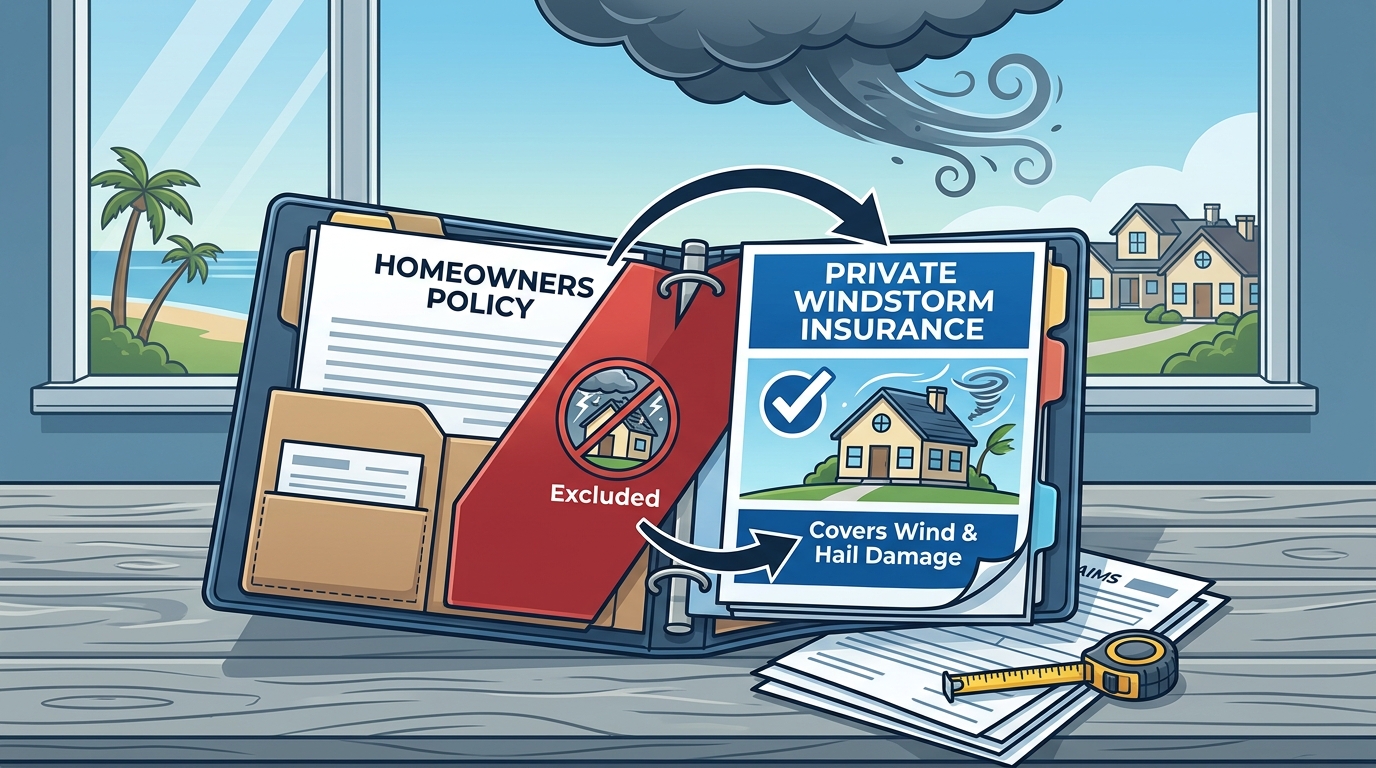
Why a storm's official classification is not the whole coverage decision
Consider a tropical storm that produces 60-mile-per-hour winds and heavy rain. Wind tears off shingles, allowing rain to enter through the newly created opening. The wind-created opening may support a windstorm claim, while water that later rises from streets, canals, bays, or storm surge may be treated as flood damage. The adjuster will examine the facts, timing, physical evidence, and policy language.
If you are uncertain about how your policy defines a covered storm or applies a wind-speed condition, arrange a policy review before hurricane season.
Wind damage, wind-driven rain, and storm surge are not interchangeable
The most important coverage distinction after a coastal storm is whether the damage resulted from wind or water. A windstorm policy is not a substitute for flood insurance.
| Damage scenario | Policy that may respond | Important qualification |
|---|---|---|
| Wind tears off shingles or damages the roof | Windstorm insurance | Subject to covered-peril language, deductible, maintenance exclusions, and limits. |
| Rain enters through a wind-damaged roof, wall, window, or door | Often windstorm or homeowners coverage | The opening and sequence of events may need to be documented. |
| Storm surge enters the home | Flood insurance | Windstorm policies generally exclude flood, storm surge, tidal water, and similar rising-water losses. |
| Rainwater accumulates and enters from the ground | Flood insurance | Coverage depends on the flood policy definition and applicable exclusions. |
| Wind-driven debris damages a covered structure | Windstorm insurance | Coverage depends on the property's status and policy terms. |
Texas windstorm policy forms distinguish wind losses from flooding and may exclude losses caused by flood, surface water, waves, storm surge, tides, tidal water, overflow of bodies of water, or spray from those sources. ([tdi.texas.gov](https://www.tdi.texas.gov/rules/2007/1220c-059.html?utm_source=openai)) FEMA similarly explains that flood insurance generally addresses water coming up from the ground, while wind-driven rain entering through wind-damaged openings is generally treated differently from flooding. ([fema.gov](https://www.fema.gov/print/pdf/node/621146?utm_source=openai))
Because a single storm can cause both wind and flood damage, coastal homeowners should consider coordinating their windstorm, home, and flood policies. You can request a flood insurance quote to evaluate the water-related portion of your protection.
Hurricane deductibles can significantly change your out-of-pocket cost
A deductible is the amount you pay before the insurer contributes to a covered loss. Some windstorm policies use a percentage deductible rather than a flat dollar amount. For example, a 2% deductible on a dwelling insured for $350,000 would equal $7,000, assuming the policy applies the percentage to that insured limit.
That example is for illustration only. Your policy may calculate the deductible differently, use another percentage, apply a minimum amount, or use separate deductibles for different covered causes of loss. Ask specifically:
- Is there a hurricane, named-storm, or windstorm deductible?
- What event activates the special deductible?
- Is the deductible based on dwelling coverage, total property limits, or another amount?
- Does the deductible apply once per occurrence or differently by item or coverage?
- Does the policy contain a waiting period or restriction on purchasing coverage before a storm?
Do not wait until a named storm is approaching to purchase coverage. Texas Department of Insurance warns that TWIA will not issue a policy when a hurricane is in the Gulf of Mexico, and other insurers may also impose binding restrictions or underwriting limitations during an active threat. ([tdi.texas.gov](https://www.tdi.texas.gov/tips/what-is-windstorm-insurance.html?utm_source=openai))
How private windstorm insurance differs from homeowners coverage and TWIA
In inland parts of Texas, wind and hail may be included in a homeowners policy. Along the Texas coast, however, homeowners insurance may exclude those perils, requiring a separate windstorm policy or another approved solution. Texas City is in a coastal region where property owners should confirm—not assume—how wind and hail are insured.
A private windstorm policy may be written by an insurer operating in the voluntary market. A private carrier may offer different underwriting requirements, deductibles, coverage limits, roof settlement provisions, endorsements, and claims procedures than another carrier.
TWIA is Texas's insurer of last resort for eligible coastal property owners who cannot obtain wind and hail coverage in the private market. Texas Department of Insurance states that applicants generally must be in the designated service area, have sought coverage from an insurer and been declined, and satisfy applicable inspection or construction-code requirements. ([tdi.texas.gov](https://www.tdi.texas.gov/tips/what-is-windstorm-insurance.html?utm_source=openai))
Private Windstorm can help Texas City homeowners compare available home, flood, and windstorm options. Start with a windstorm insurance quote to identify the coverage structure that may fit your property.
Replacement cost and actual cash value
Two important settlement approaches are replacement cost value and actual cash value. Replacement cost generally addresses the cost to repair or replace covered property with materials of similar kind and quality, subject to policy conditions and limits. Actual cash value generally accounts for depreciation, meaning an older roof or other worn component may produce a lower payment.
Ask how your roof, siding, fencing, personal property, and other covered items will be valued. A lower premium can be outweighed by a larger coverage gap after a major storm.
WPI-8 and windstorm eligibility
Some Texas coastal properties may need documentation showing compliance with applicable windstorm construction standards. A WPI-8 certificate is commonly associated with proof of compliance for eligible structures and may matter for mortgage, insurance, or construction records. Review the property's documentation before changing carriers or beginning major improvements. Private Windstorm offers a WPI-8 Certificate Guide for homeowners researching this requirement.
Common exclusions and limitations to check before hurricane season
Even when a policy covers hurricane and tropical-storm wind, it may not cover every loss connected with the event. Review these issues carefully:
Flood and storm surge
Rising water, storm surge, tidal water, and surface-water flooding are commonly excluded from windstorm policies. Separate flood insurance is usually needed for those risks.
Wear, tear, and inadequate maintenance
Insurance is generally intended for sudden and accidental covered damage, not ordinary deterioration. Missing shingles, an aging roof, rotted wood, defective construction, or long-term leaks may affect claim eligibility or the amount payable. Photograph your property and complete reasonable maintenance before storm season.
Earth movement
Earthquake, sinkhole, settling, or other earth-movement losses may be excluded or separately limited. Do not assume that a hurricane-related ground problem is covered simply because it occurred during the storm.
Ordinance or law costs
After a severe loss, local building codes may require stronger materials, electrical upgrades, elevation work, or other improvements. Standard coverage may not fully pay the increased cost of complying with current laws unless ordinance or law coverage is included.
Discuss these limitations during a free consultation so you can identify potential gaps before a claim.
What to do if a hurricane or tropical storm damages your home
- Put safety first. Leave the property if it is structurally unsafe, has electrical hazards, or is under an evacuation order.
- Prevent additional damage when reasonably safe. Use temporary measures such as tarps or plywood when appropriate, but avoid dangerous work.
- Document before cleaning up. Take wide and close-up photographs and videos of the roof, exterior, interior, debris, damaged belongings, and visible water lines.
- Separate wind and flood evidence. Photograph openings created by wind, water-entry points, standing-water levels, and the direction or pattern of damage.
- Report the claim promptly. Use your insurer's claims number, online portal, or agent. You can also report a claim through the appropriate channel.
- Keep receipts and records. Save invoices for emergency repairs, temporary lodging, materials, contractors, and damaged-property replacement.
- Do not discard damaged items too early. Preserve evidence unless it creates a health or safety hazard, and ask the adjuster how to handle disposal.
- Review the adjuster's findings. Compare the inspection with your photographs, contractor estimates, inventory, and policy provisions. Ask questions in writing if an item is omitted or denied.
Texas Department of Insurance says TWIA policyholders generally have one year from the storm to file a claim, although homeowners should follow the exact deadline and notice requirements in their own policy. ([tdi.texas.gov](https://www.tdi.texas.gov/tips/what-is-windstorm-insurance.html?utm_source=openai))
If a mortgage is involved, claim payments may include the lender or be issued in stages as repairs progress. Keep your lender informed and ask your agent or carrier about the payment process. You can make a payment or manage policy-related needs through the appropriate online service.
Key takeaways for Texas City homeowners
- Private windstorm insurance generally may cover direct wind damage from both named hurricanes and tropical storms.
- The storm's name or category does not guarantee payment; the cause of damage and policy wording control.
- Wind damage and flood damage are different insurance questions. Storm surge and rising water generally require flood insurance.
- Wind-driven rain entering through a wind-created opening may be treated differently from water that enters through flooding.
- Hurricane or named-storm deductibles may be percentage-based and substantially higher than a flat deductible.
- Roof condition, maintenance, replacement-cost terms, exclusions, limits, and endorsements can materially affect a claim.
- Coastal homeowners may obtain coverage from a private insurer, TWIA, or another eligible market option depending on availability and underwriting.
- Coverage should be arranged before a storm threatens the Gulf Coast because insurers may restrict new applications or binders during an active event.
- Brad Spurgeon Insurance Agency and Private Windstorm help homeowners in Texas City and surrounding areas evaluate home, flood, and windstorm insurance options.
Frequently asked questions
Does private windstorm insurance cover a named hurricane?
It often covers direct physical damage caused by hurricane-force wind, subject to the policy's covered-peril language, deductible, exclusions, limits, and conditions. A named storm does not automatically make every related loss covered. Storm surge, rising water, and other flood damage are generally handled separately.
Does private windstorm insurance cover tropical-storm damage?
It may cover direct wind damage caused by a tropical storm, including roof, siding, window, door, or debris impact damage, if those losses fall within the policy's definition of a covered windstorm. Review whether a named-storm or other special deductible applies.
Will windstorm insurance pay for storm surge?
Generally, no. Storm surge and other damage caused by rising water are commonly excluded from windstorm policies. Separate flood insurance may be needed for that exposure.
What if rain enters after wind damages my roof?
Rain entering through a roof, wall, window, or door opening created by covered wind damage may be considered part of the wind loss, depending on the policy and evidence. Photograph the opening and the interior damage before making permanent repairs.
Is hurricane damage subject to a special deductible?
Many policies use a separate hurricane, named-storm, or windstorm deductible. It may be a percentage of the dwelling limit rather than a flat dollar amount. Ask your agent to show the deductible calculation using your current insured value.
Can I buy private windstorm insurance after a hurricane is in the Gulf?
Usually, you should not expect immediate coverage during an active threat. Insurers may suspend binding, impose waiting periods, or decline new applications. Texas Department of Insurance specifically warns that TWIA will not issue a policy if a hurricane is in the Gulf of Mexico. ([tdi.texas.gov](https://www.tdi.texas.gov/tips/what-is-windstorm-insurance.html?utm_source=openai))
Does windstorm insurance cover roof damage from high winds?
Roof damage from covered high winds may be covered, but normal wear, deterioration, faulty installation, and inadequate maintenance may be excluded or affect the settlement. Confirm whether the policy pays replacement cost or actual cash value for the roof.
What is the difference between windstorm and flood insurance?
Windstorm insurance addresses damage caused by the force of wind and related covered consequences. Flood insurance addresses qualifying flood damage, including certain rising-water and storm-surge losses. Coastal homeowners may need both policies because one does not replace the other.
Can homeowners in high-risk coastal areas obtain windstorm coverage?
Possibly. Coverage may be available through a private carrier or, when private-market coverage is unavailable and eligibility requirements are met, TWIA. Property location, construction characteristics, inspection records, prior losses, and underwriting rules can affect eligibility.
What is a WPI-8 certificate?
A WPI-8 certificate is Texas windstorm documentation associated with demonstrating compliance with applicable windstorm construction standards. It can be important for certain coastal properties, insurance arrangements, financing, or construction records. Review the property's records before making a policy change.
Review your hurricane and tropical-storm protection before the next threat
The right answer for your home depends on the policy—not just the word “hurricane” on a quote or declarations page. A coverage review can identify whether your windstorm policy includes the right dwelling limit, how your roof is valued, what deductible applies, whether additional living expenses are available, and whether flood insurance is needed for storm surge and rising water.
Brad Spurgeon Insurance Agency serves Texas City, TX, and surrounding communities with tailored home, flood, and windstorm insurance solutions. Schedule a free consultation or request a home insurance quote before storm conditions make coverage harder to obtain.