

Homeowners in high-risk coastal regions face a complex insurance landscape where standard policies often exclude wind damage. According to recent financial research, the retreat of private insurers from volatile markets has forced many property owners to rely on state-backed alternatives for basic protection. Understanding the structural differences between these options is critical for maintaining adequate coverage without overpaying for redundant features. (Home Flood amp Windstorm)
Coverage Basics and Exclusions
The fundamental difference lies in what is actually covered. Private market windstorm policies are often standalone policies or endorsements that fill the gap left by standard homeowners insurance. These policies are designed to cover direct physical loss to your home and personal property caused by wind, hail, and sometimes tornadoes. They typically include debris removal and additional living expenses if your home becomes uninhabitable after a storm. (Windstorm and Hail) (Home Insurance Flood Windstorm)
State-run pools, often referred to as "insurers of last resort," provide a safety net when the private market withdraws. Data shows that in markets like Florida, state-operated entities have become vital as private insurers exit due to financial performance issues. These pools generally offer basic dwelling coverage but may have stricter limits on personal property or additional living expenses compared to comprehensive private policies. (Home Insurance Flood Windstorm)
Windstorm insurance provides coverage for property damage caused by wind events, which is distinct from flood damage. It is crucial to note that neither private windstorm policies nor state pools typically cover flood damage. Flood insurance requires a separate policy, often through the National Flood Insurance Program (NFIP) or private flood insurers. This distinction is vital for coastal homeowners who face both wind and water risks. (Windstorm Insurance Inspections Brad)
Cost Structure and Pricing Models
Pricing mechanisms differ significantly between the two models. Private insurers use actuarial data to price risk based on specific property characteristics, such as roof age, construction materials, and proximity to the coast. This allows for granular pricing where well-mitigated homes may receive lower premiums. Private companies also offer discounts for storm shutters, reinforced roofing, and other wind-resistant improvements.
State-run pools often utilize a more uniform rating structure. While they may adjust rates based on risk zones, they generally do not offer the same level of personalized discounts as private carriers. This can result in higher costs for homeowners who have invested in mitigation efforts but are forced into a pool with standardized pricing. Additionally, state pools may impose surcharges or fees that are not present in private market policies.
When comparing costs, homeowners must also consider the deductible structure. Private windstorm policies often allow for higher deductibles, which can lower monthly premiums. State pools may have fixed deductible requirements that are less flexible. This flexibility in private markets allows homeowners to manage cash flow by choosing a deductible they can afford in the event of a claim. (Windstorm and Hail)
Claims Processing and Payouts
The experience of filing a claim is often where the differences become most apparent. Private insurance companies typically have dedicated claims teams and established relationships with local contractors. This can lead to faster initial assessments and more streamlined repair processes. Many private insurers also offer advanced digital tools for tracking claim status and uploading documentation.
State-run pools may rely on third-party administrators or have limited local staff, which can slow down the claims process. In times of widespread disaster, such as a major hurricane, state pools may face capacity constraints that delay payouts. According to regulatory guidelines, state pools are authorized to write essential coverage, but their operational capacity is often tested during peak storm seasons. Homeowners should be prepared for potentially longer wait times for inspection and payment.
Transparency in claims handling is another key differentiator. Private insurers are often more proactive in communicating with policyholders throughout the process. They may assign a specific adjuster to your case, providing a single point of contact. State pools may use a more centralized system where communication is less personalized. This can make it harder for homeowners to get updates on their claim status.
Eligibility and Underwriting Standards
Eligibility for coverage varies widely between private and state-run options. Private insurers have the right to underwrite risk and may decline coverage for homes that do not meet specific criteria. For example, a home with an old roof or outdated electrical systems might be denied windstorm coverage by a private carrier. This can leave homeowners with limited options.
State-run pools are designed to provide coverage to those who cannot find it in the private market. As a result, they often have more lenient underwriting standards. However, this does not mean they accept all risks. They may still require certain mitigation measures, such as hurricane straps or impact-resistant windows, to qualify for coverage. These requirements are often less stringent than those of private insurers but still exist to manage the pool's overall risk.
For homeowners in high-risk zones, the choice between private and state coverage may not be a choice at all. If private insurers have exited the market, the state pool may be the only option. This is particularly true in regions like the Texas Gulf Coast, where wind and hail risks are significant. Brad Spurgeon Insurance Agency Inc. specializes in navigating these complex markets to find the best available coverage for our clients.
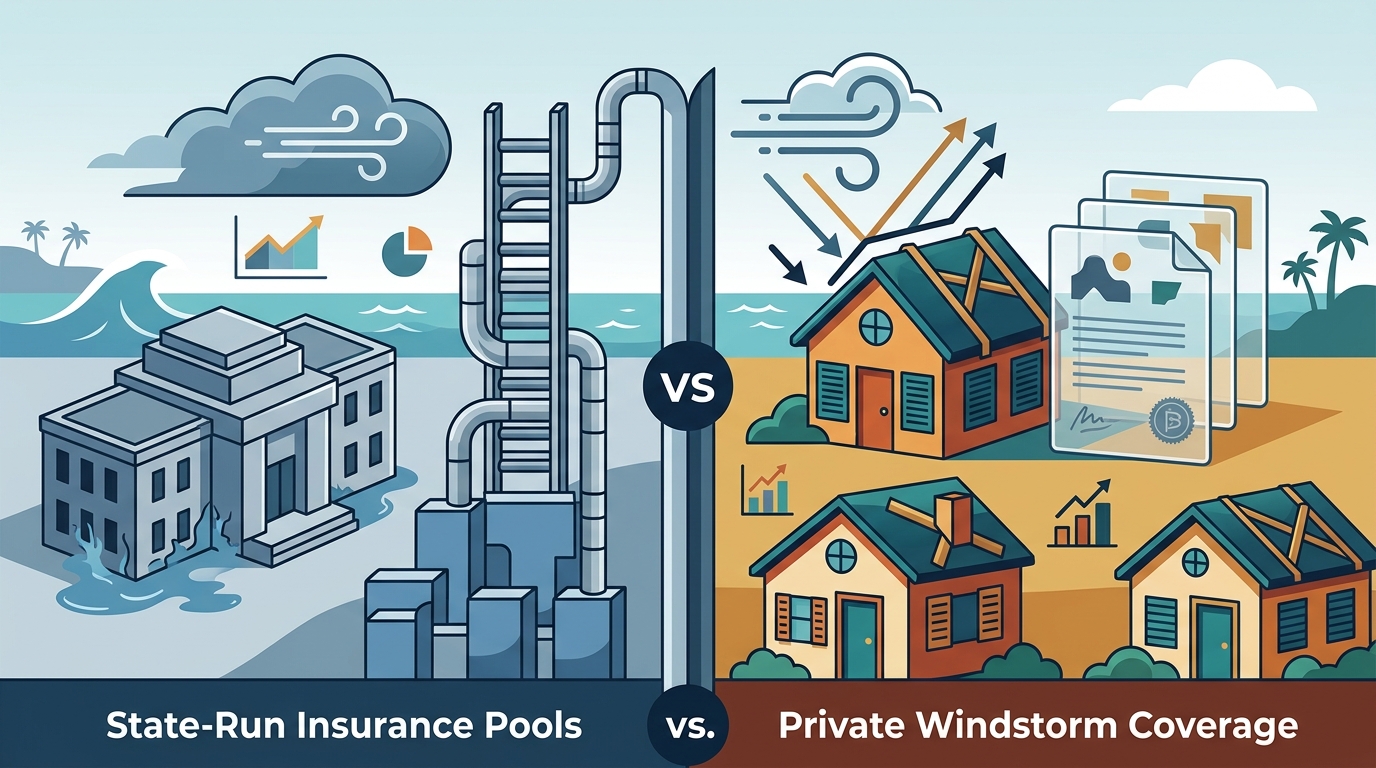
Comparison Summary
| Feature | Private Windstorm Coverage | State-Run Insurance Pool |
|---|---|---|
| Pricing Flexibility | High (based on mitigation and risk) | Low (standardized rating) |
| Discounts | Available for storm shutters, etc. | Limited or none |
| Claims Speed | Generally faster with local adjusters | May be slower during peak seasons |
| Eligibility | Strict underwriting standards | More lenient, safety net role |
| Customer Service | Dedicated agents and digital tools | Centralized or third-party admin |
Key Takeaways
- Private windstorm policies offer greater pricing flexibility and discounts for mitigation efforts.
- State-run pools serve as a critical safety net when private insurers withdraw from high-risk markets.
- Claims processing is often faster and more personalized with private carriers.
- Neither private windstorm nor state pool policies cover flood damage; separate flood insurance is required.
- Brad Spurgeon Insurance Agency Inc. has served the Texas Gulf Coast since 1986, providing expert guidance on these complex products. (Wind Fire Water)
- Eligibility for state pools is generally more lenient, making them accessible to a wider range of homeowners.
- Understanding the specific terms of your policy is essential to avoid coverage gaps during a disaster.
Frequently Asked Questions
Do state-run pools cover flood damage?
No, state-run windstorm pools typically do not cover flood damage. Flood insurance must be purchased separately, often through the National Flood Insurance Program or private flood insurers.
Can I get discounts with a state-run insurance pool?
State-run pools generally offer fewer discounts than private insurers. They may have limited options for mitigation discounts compared to private carriers that reward storm-resistant improvements.
What happens if a private insurer exits my market?
If a private insurer exits your market, you may need to seek coverage through a state-run pool or a residual market mechanism. This is why having a knowledgeable agent is crucial for navigating these transitions.
How do deductibles differ between private and state policies?
Private policies often allow for higher, customizable deductibles that can lower premiums. State pools may have fixed deductible requirements that are less flexible.
Is windstorm insurance the same as homeowners insurance?
No, standard homeowners insurance often excludes wind damage in high-risk areas. Windstorm insurance is a separate policy or endorsement designed specifically for wind-related losses.
Who is eligible for state-run windstorm coverage?
State-run pools are designed to provide coverage to homeowners who cannot find it in the private market. Eligibility is generally more lenient, but certain mitigation requirements may still apply.
How can I file a claim with my insurance provider?
You can file a claim through your provider's online portal or by contacting their claims department. For Brad Spurgeon Insurance Agency Inc. clients, you can report a claim directly through our online service center.
What is the WPI-8 certificate?
The WPI-8 certificate is a document that outlines the specific terms and conditions of windstorm insurance policies in Texas. It is essential for understanding your coverage limits and exclusions. Learn more about the WPI-8 Certificate Guide on our website.
Secure Your Coverage
Navigating the differences between state-run pools and private windstorm coverage requires expert guidance. At Brad Spurgeon Insurance Agency Inc., we specialize in helping Texas Gulf Coast homeowners secure the right protection. Our team has decades of experience in homeowners, windstorm, and flood insurance. We provide personalized consultations to ensure your coverage meets your specific needs. Contact us today to get a free quote and peace of mind. Visit our Home Insurance Quote page to start your journey.