

Property owners in high-risk coastal zones face escalating exposure to severe weather events. According to recent federal data, coastal property owners face a 26 percent higher probability of filing a wind-related claim. This statistical reality forces homeowners to evaluate their protection options carefully. State-run insurance pools and private market carriers operate under fundamentally different frameworks. Understanding these operational distinctions determines whether your property receives adequate financial protection during a catastrophic event. You must align your policy selection with your specific geographic exposure and long-term asset preservation goals. (Home Insurance Flood Windstorm)
Understanding Core Insurance Models
State-run insurance pool is a government-backed entity created to provide coverage in high-risk coastal regions. Private market windstorm coverage is a commercially underwritten policy offered by independent insurance carriers. Flood risk assessment is the systematic evaluation of geographic exposure to water damage and storm surge. These three concepts form the foundation of modern property protection strategies. Each model approaches risk distribution differently. Government entities prioritize broad accessibility and community stability. Private carriers prioritize actuarial precision and capital efficiency. Homeowners must recognize that these philosophical differences directly impact policy terms, premium calculations, and long-term financial exposure. (Auto Insurance Brad Spurgeon)
Government-backed programs typically operate under legislative mandates. They accept applicants who might otherwise be declined by commercial underwriters. Private carriers utilize proprietary risk modeling to price policies based on construction materials, elevation data, and historical loss patterns. The Texas City insurance market demonstrates both approaches in active operation. Local agencies facilitate seamless transitions between these models. You can explore comprehensive protection options by visiting our windstorm insurance quote portal. This resource helps you compare available pathways without committing to a single underwriting track.
Cost Structure and Premium Variance
Premium calculations differ significantly between public and private frameworks. State pools often utilize subsidized rating structures to maintain affordability for vulnerable populations. Private carriers apply risk-based pricing that reflects exact property characteristics. Insurance Information Institute reports indicate that private policies frequently carry higher upfront premiums but deliver substantially broader indemnity limits. This pricing model rewards property improvements and proactive risk mitigation. Homeowners who install impact-resistant windows or reinforce roof trusses often see immediate premium reductions. Government programs rarely offer dynamic discounting mechanisms. They maintain flat rating schedules that prioritize uniformity over individualized pricing.
Administrative overhead also influences final premium costs. Public entities operate under legislative budget constraints. They cannot adjust reserves rapidly when catastrophic events occur. Private carriers maintain dedicated capital reserves and reinsurance agreements to absorb sudden loss spikes. This financial infrastructure allows private policies to scale coverage limits without triggering legislative approval processes. You can review our detailed flood insurance resources to understand how premium structures adapt to changing risk environments. Transparent pricing remains a core advantage of the private market.
Coverage Limits and Policy Flexibility
State-run programs typically enforce statutory coverage caps. These limits often fall short of current construction and replacement costs. Private carriers offer customizable limit structures that scale with property value. You can select coverage amounts that match your actual rebuilding budget. Policy endorsements also differ substantially between the two models. Private carriers allow homeowners to add specific riders for high-value items, temporary living expenses, and code upgrade requirements. Government programs rarely permit modular policy adjustments. They provide standardized packages that prioritize basic structural protection over comprehensive asset coverage.
Building code compliance represents another critical differentiator. Private policies frequently include ordinance or law coverage that pays for upgraded materials required by modern municipal codes. State pools often exclude these additional reconstruction costs. This gap creates significant financial exposure during post-storm rebuilding phases. Homeowners who prioritize long-term asset preservation should evaluate their rebuilding budget against available policy limits. Our agency team specializes in mapping coverage gaps to specific property vulnerabilities. We ensure your policy structure aligns with current construction costs and municipal regulations.
Claims Processing and Adjuster Allocation
Post-disaster claims handling reveals the most visible operational differences between insurance models. State pools frequently experience severe adjuster shortages during major weather events. These shortages create extended processing delays that strain homeowner finances. Private carriers maintain dedicated claims networks and independent adjuster contracts to accelerate assessment timelines. Insurance Information Institute reports indicate that private carriers typically resolve standard wind claims 40 percent faster than government-backed programs. This speed advantage directly impacts temporary housing costs and recovery timelines.
Claims documentation requirements also vary significantly. Private carriers utilize digital submission platforms that streamline evidence collection. Homeowners can upload photographs, repair estimates, and inventory lists through secure portals. Government programs often require physical document submission and manual file reviews. This administrative friction extends processing windows and increases compliance burdens. You can track your claim status efficiently by accessing our claims reporting dashboard. This system provides real-time updates and direct communication channels with your assigned adjuster.
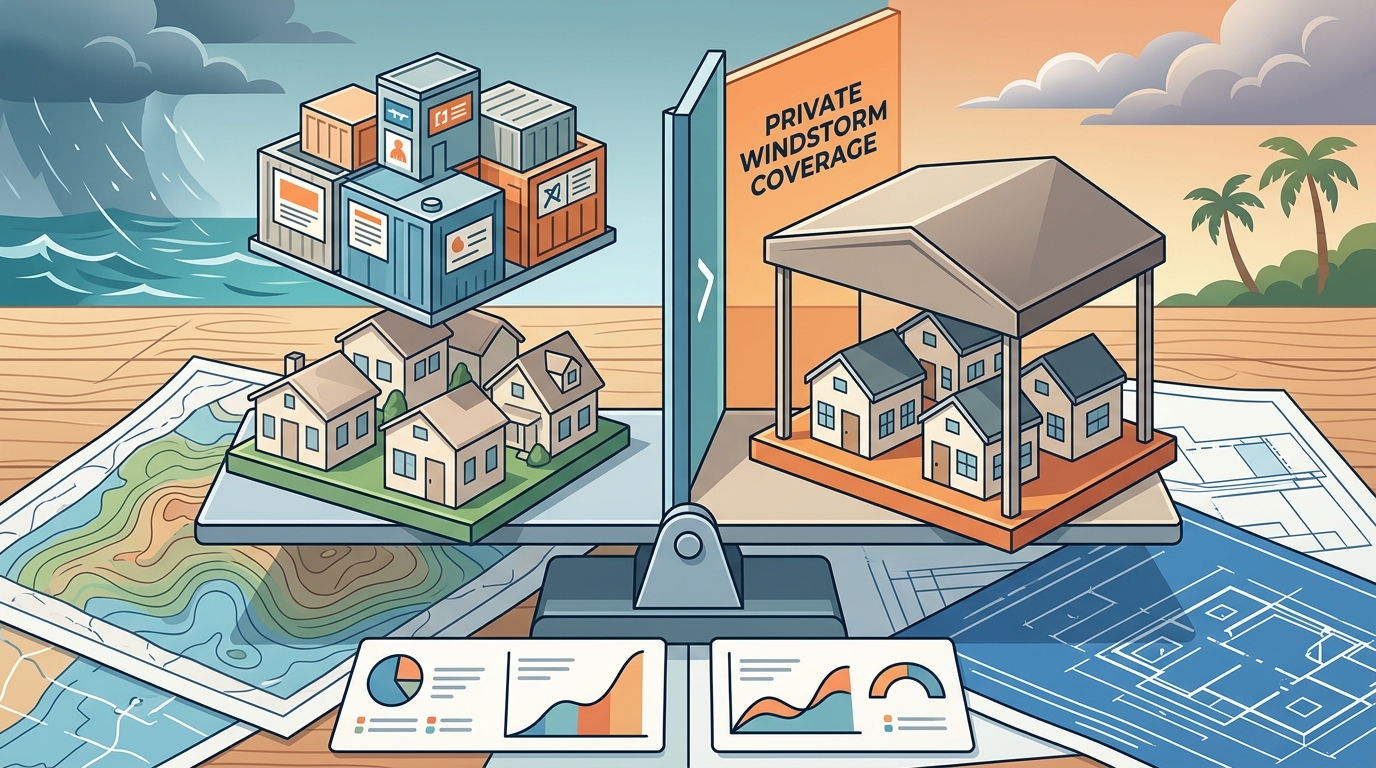
Risk Assessment and Geographic Targeting
Underwriting methodologies determine which properties qualify for coverage and at what price points. State pools utilize broad geographic zoning maps to determine eligibility. These maps rarely account for hyperlocal elevation changes, drainage patterns, or wind tunnel effects. Private carriers employ advanced meteorological modeling and historical loss data to evaluate individual properties. This granular approach allows carriers to accept high-risk properties that would otherwise be excluded from the market. They simply price the specific exposure accurately rather than applying blanket restrictions.
Geographic targeting also influences long-term policy availability. Government programs frequently face legislative pressure to expand coverage into newly identified risk zones. This expansion often triggers premium increases for all policyholders. Private carriers adjust their geographic exposure limits based on capital adequacy and reinsurance market conditions. This dynamic approach prevents systemic premium inflation across entire regions. Homeowners should monitor how their specific property coordinates align with available underwriting guidelines. Our industry insights provide ongoing analysis of shifting risk parameters and coverage availability.
| Feature Category | State-Run Insurance Pool | Private Market Coverage |
|---|---|---|
| Premium Structure | Subsidized flat rates | Risk-based dynamic pricing |
| Coverage Limits | Statutory maximum caps | Customizable high-limit options |
| Claims Processing | Extended timelines during disasters | Accelerated digital workflows |
| Policy Flexibility | Standardized packages only | Modular endorsements available |
| Code Upgrade Coverage | Typically excluded | Frequently included |
Key Takeaways
- State-run insurance pool is a government-backed entity created to provide coverage in high-risk coastal regions.
- Private market windstorm coverage is a commercially underwritten policy offered by independent insurance carriers.
- Flood risk assessment is the systematic evaluation of geographic exposure to water damage and storm surge.
- Private carriers typically resolve standard wind claims 40 percent faster than government-backed programs.
- State pools enforce statutory coverage caps that often fall short of current construction costs.
- Private policies frequently include ordinance or law coverage for upgraded municipal materials.
- Homeowners in Texas City benefit from comparing both models before finalizing policy selection.
Frequently Asked Questions
Can I switch from a state pool to private coverage mid-policy?
Yes, policyholders can transition to private coverage during standard renewal windows. You must submit a new application and undergo current underwriting evaluation. Our team assists with seamless policy transitions to prevent coverage gaps.
Do state pools cover wind damage or only flood damage?
Most state programs offer separate windstorm endorsements that operate alongside basic flood coverage. These endorsements follow identical statutory limits and claims procedures. Private carriers typically bundle wind and flood protection into unified policies.
How do premium subsidies affect long-term policy costs?
Subsidized premiums often increase when legislative bodies adjust rating structures. Private carriers maintain stable pricing through actuarial adjustments and reinsurance agreements. Long-term cost predictability favors private market structures.
What happens to my coverage if a major hurricane hits my region?
State pools frequently experience adjuster shortages and processing delays during major events. Private carriers maintain dedicated claims networks to accelerate assessment timelines. Your policy structure determines your recovery speed and financial stability.
Are there properties that cannot obtain private windstorm coverage?
Extremely high-risk structures may face temporary underwriting restrictions. Private carriers periodically reopen coverage windows when capital reserves stabilize. Our agency monitors market conditions to secure placement for challenging properties.
How does building elevation impact my policy options?
Elevation data directly influences risk-based pricing calculations. Properties above base flood elevation levels typically qualify for lower private premiums. State pools apply uniform rating schedules regardless of elevation differences.
What documentation do I need to compare both coverage models?
You will need your current policy declarations, property survey, and recent repair records. Our consultation process organizes these documents to generate accurate side-by-side comparisons. This data drives precise coverage recommendations.
Secure Your Property Protection
Choosing between state-run programs and private market coverage requires careful evaluation of your specific property characteristics and long-term financial goals. Our agency specializes in navigating both frameworks to deliver optimal protection strategies. We analyze your elevation data, construction materials, and historical loss patterns to recommend the most cost-effective pathway. Visit our main portal to schedule a comprehensive policy review. Our licensed advisors will map your coverage gaps and implement a protection strategy that aligns with your asset preservation objectives.