
Homeowners in high-risk coastal zones face a unique financial reality where standard property policies exclude wind damage. According to recent industry data, wind and hail claims account for approximately 40% of all property insurance losses in Texas, driving premiums significantly higher than the national average for standard home insurance. This exclusion necessitates a separate windstorm policy, often referred to as a WPI-8 endorsement or a standalone policy, depending on the carrier. Understanding the specific variables that drive these costs is essential for budgeting and risk management in regions like Texas City and the broader Gulf Coast. (Home Insurance Flood Windstorm)
Location and Geographic Risk Zones
The single most significant determinant of your windstorm premium is your precise geographic location. Insurance carriers utilize sophisticated modeling software to assess wind speed probabilities, storm surge potential, and historical loss data for specific zip codes. In Texas, the Coastal Barrier Risk System (CBRS) and Federal Emergency Management Agency (FEMA) flood zones play a critical role in this assessment. (Home Insurance Flood Windstorm)
Properties located within the first few miles of the Gulf Coast are classified as high-risk zones. These areas are subject to higher wind speed maps, which directly correlate to increased premium costs. For instance, a home in Texas City faces different risk parameters than one located further inland in Houston. The proximity to the water not only increases the likelihood of wind damage but also the potential for catastrophic storm surge, which can compound structural failures. (Windstorm Insurance Inspections Brad)
Windstorm insurance is designed to cover damage from wind, hail, and lightning, but it explicitly excludes flood damage. This distinction is vital because flood insurance is typically provided through the National Flood Insurance Program (NFIP) or private flood carriers. The intersection of these two risks creates a complex underwriting landscape. Carriers like those available through Private Windstorm specialize in navigating these specific coastal complexities to ensure you are not left exposed. (Auto Insurance Brad Spurgeon)
Construction Type and Building Materials
The physical structure of your home dictates how it withstands high-velocity winds. Older homes built before modern building codes were implemented are often viewed as higher risks. The age of the roof, the type of foundation, and the quality of the framing all contribute to the underwriting decision.
Roof age is a primary factor. Most carriers require that the roof be less than 10 to 15 years old to qualify for standard windstorm coverage. If your roof is older, you may face a significantly higher premium or be required to replace the roof before a policy can be issued. This is because older shingles are more susceptible to tearing off during high winds, leading to interior water damage and structural compromise.
Building materials also matter. Homes constructed with concrete block or brick veneer generally perform better in high winds than those with wood frame siding. Additionally, the roof shape plays a role. Hip roofs, which slope on all four sides, are more aerodynamic and resistant to wind uplift than gable roofs, which have vertical ends that can catch the wind. Understanding these structural nuances can help you anticipate premium variances.
Mitigation Discounts and Code Compliance
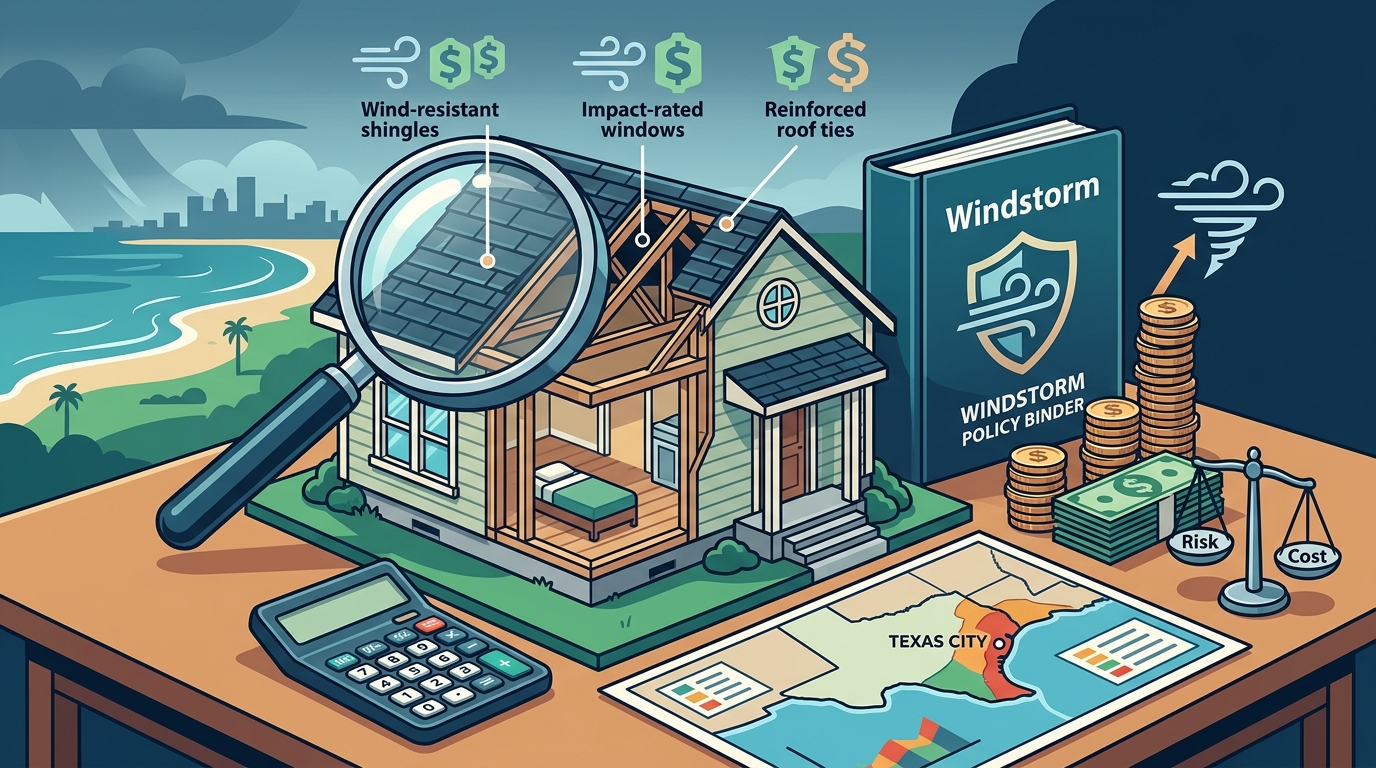
One of the most effective ways to lower your windstorm premium is through mitigation. Carriers offer substantial discounts to homeowners who have taken steps to reinforce their property against wind damage. These discounts are not automatic; you must provide proof of installation and often a certificate of compliance.
Common mitigation measures include:
- Impact-Resistant Windows: Windows rated to withstand high-velocity projectiles reduce the risk of breaching the home's envelope.
- Roof Reinforcement: Using hurricane straps or clips to secure the roof trusses to the wall framing.
- Secondary Water Barrier: Installing a self-adhering membrane under the shingles to prevent water intrusion if the shingles are lost.
In Texas, the WPI-8 endorsement is a standard form used by many carriers to provide windstorm coverage. This endorsement often includes specific requirements for mitigation. For example, if your home meets the Texas Department of Insurance (TDI) wind mitigation standards, you may qualify for a discount of up to 20% or more on your windstorm premium. Consulting with a local agent who understands these specific code requirements is crucial to maximizing these savings.
Coverage Limits and Deductible Structures
The amount of coverage you choose and the type of deductible you select will directly impact your premium. Windstorm deductibles are often calculated as a percentage of your dwelling coverage limit, rather than a flat dollar amount. This is known as a percentage deductible.
For example, if your home is insured for $500,000 and you have a 2% wind deductible, your out-of-pocket cost for a wind claim would be $10,000. Choosing a higher percentage deductible, such as 4% or 5%, can significantly lower your annual premium. However, this also means you are assuming more financial risk in the event of a storm. It is essential to balance your budget with your ability to pay a high deductible in a crisis. (How Climate Risks)
Additionally, you must consider the difference between replacement cost value (RCV) and actual cash value (ACV). RCV pays to replace your home with materials of like kind and quality without deducting for depreciation. ACV pays the replacement cost minus depreciation. RCV is generally more expensive but provides much better protection. For coastal homes, where construction costs can be high due to material and labor demands, RCV is often the recommended choice.
Carrier Selection and Financial Stability
Not all insurance carriers write windstorm policies in high-risk coastal areas. The Texas wind and hail market has seen significant consolidation, with many national carriers exiting the state due to high loss ratios. This leaves a limited number of carriers willing to write these policies, often at higher rates.
Financial stability is a critical factor when choosing a carrier. You want to ensure that the company has the financial strength to pay claims after a major hurricane event. Ratings from agencies like A.M. Best and Standard & Poor's provide insight into a carrier's financial health. Carriers with higher ratings are generally more stable but may not always offer the lowest premiums.
Working with a local agency that has access to multiple carriers can help you find the best balance of price and stability. Private Windstorm partners with a variety of top-rated carriers to provide options for Texas City homeowners. This multi-carrier approach allows for comparative quoting, ensuring you get the most competitive rate available for your specific risk profile.
Premium Factor Comparison
The following table summarizes how different factors influence your windstorm premium costs. Understanding these relationships can help you make informed decisions about your coverage.
| Factor | Impact on Premium | Mitigation Strategy |
|---|---|---|
| Proximity to Coast | High Increase | Understand risk zones and budget accordingly. |
| Roof Age | High Increase if >10 years | Replace roof or install secondary water barrier. |
| Deductible Type | Variable | Choose a higher percentage deductible to lower cost. |
| Mitigation Features | Decrease (Discounts) | Install hurricane straps and impact windows. |
| Carrier Choice | Variable | Compare quotes from multiple specialized carriers. |
Key Takeaways
- Windstorm premiums in Texas are driven by geographic risk, with coastal zones facing the highest rates due to storm surge and wind speed probabilities.
- Roof age is a critical underwriting factor; roofs older than 10-15 years often result in higher premiums or denial of coverage.
- Mitigation discounts are available for homes that meet specific wind-resistant construction standards, such as those outlined in the WPI-8 endorsement.
- Percentage deductibles are standard for windstorm policies, meaning your out-of-pocket cost is a % of your dwelling coverage limit.
- Many national carriers have exited the Texas wind market, making local agency access to specialized carriers essential for obtaining coverage.
- Flood insurance is separate from windstorm insurance and is required in most high-risk coastal flood zones.
- Regular policy reviews are necessary to ensure your coverage limits keep pace with rising construction costs in the Gulf Coast region.
Frequently Asked Questions
What is the difference between windstorm insurance and flood insurance?
Windstorm insurance covers damage caused by wind, hail, and lightning, such as roof damage or broken windows. Flood insurance covers damage from rising water, including storm surge and heavy rainfall that overflows land boundaries. These are two distinct types of coverage that are typically sold separately.
How is the windstorm deductible calculated?
Windstorm deductibles are usually calculated as a percentage of your dwelling coverage limit. For example, a 2% deductible on a $400,000 home would require you to pay $8,000 out of pocket before insurance coverage begins for a wind claim.
Can I get windstorm insurance if my roof is older than 10 years?
It is possible, but it may be more difficult and expensive. Many carriers have strict age limits for roofs. If your roof is older, you may need to provide a recent inspection report or replace the roof to qualify for coverage.
What is the WPI-8 endorsement?
The WPI-8 is a standard endorsement used by many insurance carriers in Texas to provide windstorm coverage. It outlines the specific terms, conditions, and exclusions for wind-related claims in the state.
Why are windstorm premiums so high in Texas?
High premiums are due to the frequency and severity of wind and hail events in Texas, combined with the high cost of construction and repairs. Additionally, the exit of many national carriers from the market has reduced competition, leading to higher rates.
Do I need both windstorm and flood insurance?
If you live in a high-risk flood zone, you likely need flood insurance if you have a mortgage. Even if you are not in a high-risk zone, windstorm damage can lead to water intrusion, making flood coverage a prudent addition for coastal homeowners.
How can I lower my windstorm premium?
You can lower your premium by installing mitigation features like hurricane straps and impact-resistant windows, choosing a higher deductible, and comparing quotes from multiple specialized carriers.
Secure Your Coastal Protection
Navigating the complexities of windstorm insurance in Texas requires expert guidance. Whether you need a new quote, a policy review, or assistance with a claim, our team is here to help. We specialize in providing comprehensive coverage solutions for homeowners in Texas City and the surrounding Gulf Coast areas. Contact us today to schedule a free consultation and ensure your home is protected against the elements.